How to Get Your Customer's Neighbors as Clients
A field-tested playbook for turning one lawn on a street into five. Learn the on-site moves, the outreach that works, and the route-density math that makes neighbor accounts your most profitable customers.
The most profitable customer you'll sign this year is probably standing in the yard next to one you already mow. Learning how to get your customer's neighbors as clients isn't a marketing luxury — it's the single fastest way to raise your revenue per hour without buying another truck, hiring another guy, or spending a dime on ads. You're already parked on the street. The mower's already off the trailer. Every account you add within a few hundred feet is nearly free money.
This is the definitive guide to doing it on purpose instead of by accident. We'll cover the economics, the on-site moves that convert while you're still on the job, and the outreach that fills a street with recurring accounts.
Why neighbor accounts beat scattered ones: lawn care route density
Everything here comes down to lawn care route density — how tightly your stops cluster together. Drive time is non-billable overhead. Every minute between stops is a minute you're burning fuel and labor with zero revenue coming in. The tighter your route, the more of your day is billable.
The numbers are stark. A recent industry presentation estimated that companies with multiple neighboring customers can see roughly 30%–40% higher profits than operators running scattered, cross-town routes. That gap isn't from charging more — it's from cutting windshield time and converting it into billable mowing.
Here's what an efficient route actually looks like in 2026:
- 12–18 properties per day within a 3–5 mile radius for a standard residential route.
- 8–12 customers within a half-mile radius in denser neighborhoods.
- 2.0–3.0 stops per hour for an efficient solo or two-person crew.
- Under 1.5 miles between stops in suburban areas, and under 0.7 miles in dense neighborhoods.
The National Association of Landscape Professionals frames the whole idea the same way: the efficiency gain comes from reducing windshield time, and the smart place to start is your existing customer base. You don't build density by chasing random leads across town. You build it by going next door.
A worked example: what one neighbor is actually worth
Say you mow a $55 lawn that takes 35 minutes of billable work. If it sits alone and costs you 20 minutes of round-trip driving to reach, your real time-on-that-account is 55 minutes — so you're netting about $60/hour before expenses.
Now sign the house next door for another $55. That second lawn adds maybe 2 minutes of drive time instead of 20. Two stops, 72 billable minutes, roughly 15 minutes total travel: $110 for about 87 minutes, or about $76/hour. Add a third on the same street and you're pushing past $85/hour on the same tank of gas. The mowing rate never changed — the route density did.
That's the whole game. Same crew, same equipment, same day, dramatically better margin. This is why mowing route density is the KPI that actually moves the needle — not raw lead count, but stops per day, windshield time, and miles between stops.
How do I get customers next door to my current customers?
The best moment to convert a neighbor is while you're still on the job and their lawn looks incredible. So the first tactics are all on-site, done before you pack up.
1. Just ask the customer
The most repeated neighbor-selling tactic for 2026 is also the simplest: ask your current customer who else on the street needs a mow. They know their neighbors. They know who's struggling to keep up, who just moved in, whose teenager quit doing it. A warm name is worth ten cold doors. Then act immediately — while the crew is still on site and the finished lawn is your best sales pitch.
Sweeten the ask with a neighbor referral incentive: a free mow or a month's discount when their referral becomes a recurring account. It costs you one cheap visit to lock in a season of density.
2. Hang door hangers on the tight radius
Before you pull off the street, hit the immediate neighbors with door hangers. Route-density playbooks consistently cite 10–30 homes around the active job as the sweet spot — the houses close enough that adding them barely touches your drive time. Keep the message specific: "We're already mowing [street name]. We can add your lawn to the same day." Same-day service on their street is a real, concrete benefit no cross-town competitor can match.
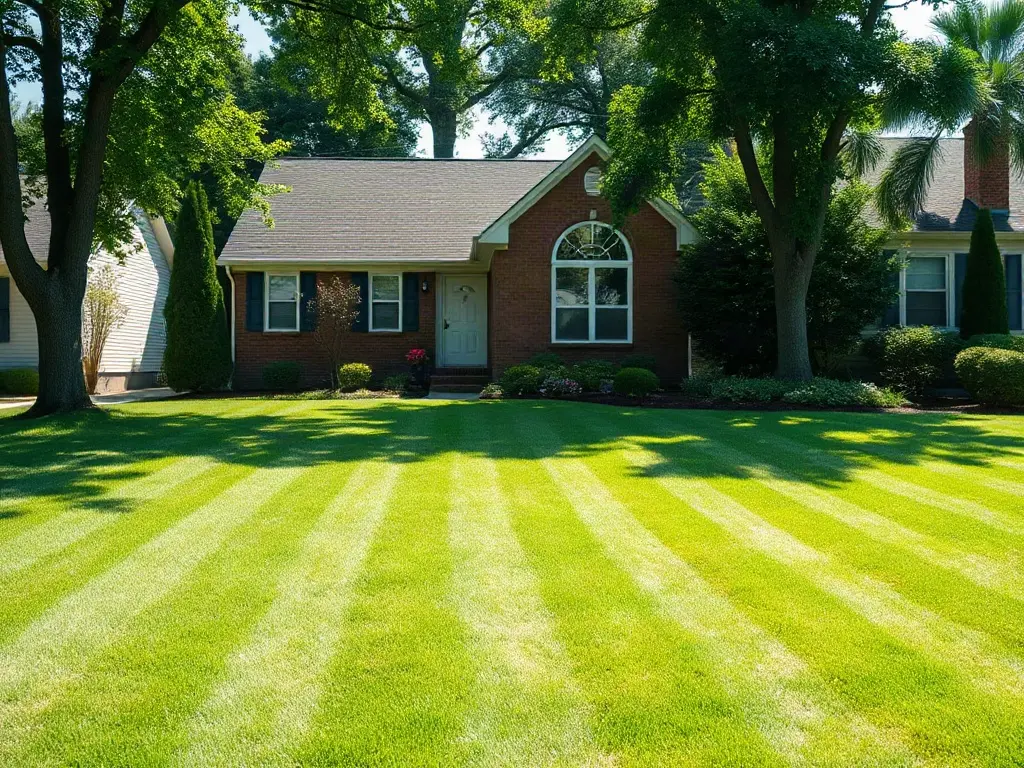
3. Put a yard sign up (with permission)
Ask your happy customers if you can stake a small yard sign while you service them. Next-door visibility is one of the strongest trends in mowing marketing right now — a clean sign on a freshly cut lawn does quiet work on every neighbor who drives past. Offer a small credit for letting you leave it up through the season.
4. Use the finished lawn to collect reviews — with a QR code
The job site is also your best review-generation moment. A QR-coded review request card, handed over when the lawn looks its best, turns satisfied customers into public proof. Neighbors who are already watching your work will Google you — and stacked local reviews close the deal before you ever knock.
How to get more lawn customers on the same street with outreach
On-site moves handle the immediate neighbors. To saturate a subdivision, add planned outreach on top.
Neighborhood direct mail
Postcards to nearby homes remain a workhorse. A common neighborhood campaign runs 300–1,500 homes, sized to how dense the area is. The key is to keep it geographically tight — you're not blanketing a zip code, you're blanketing the blocks around routes you already run. Lead with the density hook: same crew, same day, less hassle. If you want a deeper breakdown of block-level tactics, our guide on how to get more lawn customers on the same street goes further.
Neighbor offers and priority scheduling
Two incentives fill streets faster than a discount alone: a neighbor offer ("we're on your street Thursdays — join and save the trip charge") and priority scheduling ("neighbors on this route get first-slot service"). Both reward the customer for helping you cluster, which is exactly the behavior that makes your route more profitable.
Keep the cut consistent
None of this works if the work is sloppy. Neighbors judge you by what they can see over the fence. Following sound mowing practice — like the one-third rule and proper mowing height that UMass Extension's turf program lays out — keeps every lawn on the block looking like a walking billboard. A street full of your stripes sells the next account for you.
The lawn care prospecting tool that finds the neighbors for you
The hard part of a neighbor campaign has always been the legwork: figuring out exactly which addresses sit within striking distance of an account, then measuring and pricing each one. That's slow when you're doing it by hand.
This is where a purpose-built lawn care prospecting tool earns its keep. Mower Math's Find Neighbors feature pulls every address within a half-mile of a customer you already service — so you can see your density opportunity on a map and measure and price each nearby lawn from aerial imagery without a site visit. You point at the street you already own and it hands you the list of houses that would tighten your route. That's the difference between hoping neighbors call and going after them on purpose.
Turn density into a routine, not a one-off
Getting a customer's neighbors as clients isn't a campaign you run once. It's a habit you build into every job:
- Before you leave a job, ask the customer for one neighbor name.
- Hang door hangers on the 10–30 closest homes.
- Leave a yard sign where you can.
- Hand off a QR review card while the lawn looks perfect.
- Once a month, mail the blocks around your densest routes.
- Track the KPIs that matter: stops per day, miles between stops, and revenue per hour — not just lead count.
Do that consistently and your routes tighten on their own. Windshield time drops, billable hours climb, and the same eight-hour day quietly starts producing 30–40% more profit. When you're ready to scale the whole route, our guide on growing a mowing route from 20 to 100 customers maps the next steps.
The neighbors are right there. Go get them.