How to Grow a Mowing Route From 20 to 100 Customers
The math and the moves to take a mowing route from 20 accounts to 100 — without buying leads you can't afford or driving your margins into the ground.
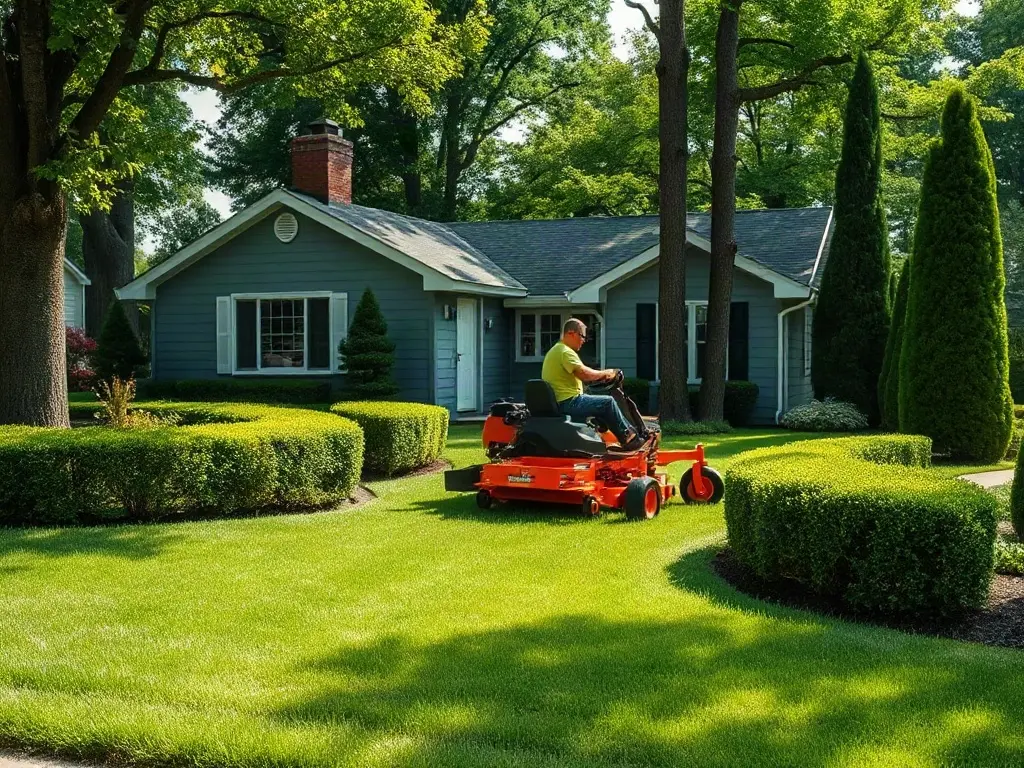
If you already mow 20 lawns a week and you want 100, the answer isn't "work harder." It's tighter routes, cheaper customer acquisition, and pricing that actually covers loaded labor. This is the practical version of how to grow a mowing route from 20 to 100 customers — the numbers, the channels, and the order to do them in.
Here's the payoff up front: getting to 100 accounts is less about a magic marketing trick and more about stacking customers close together so each new one costs less to serve than the last. Do that, and you can add 80 lawns without adding 80 lawns' worth of windshield time.
Start with the number: how many customers does a lawn business need?
Run the math before you run the ads. At a national average around $50 per cut for a quarter-acre lot, 100 weekly accounts is roughly $5,000 a week in mowing revenue during peak season — about $130,000 over a 26-week season from mowing alone, before add-ons.
A solo operator can realistically service 30–45 lawns a week solo; a two-person crew can push past 100 if the route is tight. So "how many customers does a lawn business need" depends on your target income, but for most crews 100 recurring accounts is the line where the business supports a full-time wage plus a helper and still throws off profit.
The trap: 100 scattered accounts across a whole city will bury you in drive time. 100 accounts inside a few zones is a real business.
Why mowing is the most profitable lawn service (when the route is dense)
Mowing gets dismissed as low-margin grunt work, but it's the backbone for a reason: it's recurring, it's predictable, and once you're already parked on a street, the marginal cost of the next lawn is tiny. That's why mowing is the most profitable lawn service for a route-based operator — not because the per-cut price is high, but because density crushes your cost per stop.
One 2026 benchmark warns that pricing below $40 per cut for a two-person crew can land below cost once labor is fully loaded. The way out isn't just charging more — it's cutting the drive time between the stops you already have. Servicing five homes on one street beats five homes across five neighborhoods every time. Route density is the single biggest lever on lawn mowing business profit margins, which is exactly why it deserves your attention before you spend a dollar on ads.
How to get lawn mowing customers fast — cheapest channels first
Customer acquisition cost for a healthy residential account commonly runs $200–$300 in 2026, and some benchmarks put it anywhere from $100–$300 depending on channel and close rate. But you don't have to pay top dollar for every customer. Work the channels in order of cost:
- Nextdoor (free, fastest): hyper-local by design, with results sometimes in 1–7 days and no required ad spend. This is how to get lawn mowing customers fast when you need cash flow this week.
- Google Business Profile (free): ranking for "lawn care near me" costs nothing but time; early traction usually takes 2–6 weeks. Set it up today so it's cooking by the time you need it.
- Door hangers ($200–$400 per 1,000): the density weapon. Hang the streets where you already have a customer. First calls typically land in 2–4 weeks.
- Paid search / Local Services Ads (last): landscaping Local Services Ads benchmark around $39 per lead and Google Search Ads around $118 per lead in 2026 — but those are lead prices, not closed customers. With a 30–50% close rate, blended CAC still lands in that $200–$300 zone. Use paid only once the free channels are maxed.
On budget: growing companies often spend 6–10% of gross revenue on advertising, with newer shops pushing 12–15% to accelerate and mature, route-full operators dropping to 3–5%. When you're clawing from 20 to 100, you're in the aggressive phase — a launch push of $500–$1,000 plus consistent door hangers is a reasonable starting point.
The density flywheel: how the last 80 customers get cheaper
Here's the move that changes the whole equation. Every time you close a lawn, immediately try to sell the two houses on either side and the three across the street. A door hanger on a street where your truck is already visible converts far better than a cold one.
A common route-management recommendation is to keep jobs within a 5–10 mile radius of your base and carve the territory into tight 3–5 mile zones, each assigned to a specific day. When you get a new lead, the first question isn't "can I fit it?" — it's "which zone and which day does it belong to?" If a lead is 12 miles from everything else, it may cost you more in drive time than it's worth, even at a good price. I dug deeper into this in our guide on how to build route density in lawn care.
A worked example
Say you've got 20 accounts spread across town, averaging 15 minutes of drive between stops. At 20 lawns that's 5 hours of pure driving a week — unbillable. Now suppose you consolidate around three zones and every new customer comes from streets you already touch. You add 30 accounts but cut average drive time to 6 minutes. That's 50 lawns with about 5 hours of driving — the same windshield time you had at 20. You didn't work more; you routed smarter. That gap is your profit, and it's why the operators who hit 100 obsess over the map, not just the phone.
To make the door-knocking count, know which addresses are worth targeting before you print hangers. Mower Math's Find Neighbors pulls every address within a half mile of a lawn you already service and measures each one from aerial imagery, so you can price the street and target the exact homes that tighten your route — no site visits, no guessing.
Don't leave margin on the table: most profitable services for a lawn care business
Once your route is dense, upsell the customers already on it. The most profitable services for a lawn care business tend to be the ones you can do while you're already parked — fertilization, weed control, aeration, mulch, and cleanups. According to NC State's TurfFiles lawn maintenance calendar, these tasks follow a predictable seasonal rhythm, which makes them easy to bundle into recurring plans instead of one-off jobs. Selling a $60 fertilization round to a mowing customer you're already visiting costs you almost nothing in acquisition — the CAC was paid the day you closed the mow.
If you're starting fresh: how to start a lawn mowing business in 2026
For anyone doing this from zero, the sequence for how to start a lawn mowing business in 2026 is the same, just earlier on the curve: lock one tight zone, set up a free Google Business Profile, work Nextdoor, and price every job off your real loaded costs — not a competitor's number. A modest $200–$500 initial marketing spend gets you the first handful of accounts; reinvest that revenue into door hangers on the same streets and the flywheel starts turning.
Twenty to 100 isn't a marketing miracle. It's dense zones, cheap-first channels, honest pricing, and add-ons on the route you already own. Do those four things in order and the math takes care of itself.