How to Get More Lawn Customers on the Same Street
A field-tested playbook for stacking accounts street by street — same-street referrals, neighbor-facing proof, and the density math that makes every stop more profitable.
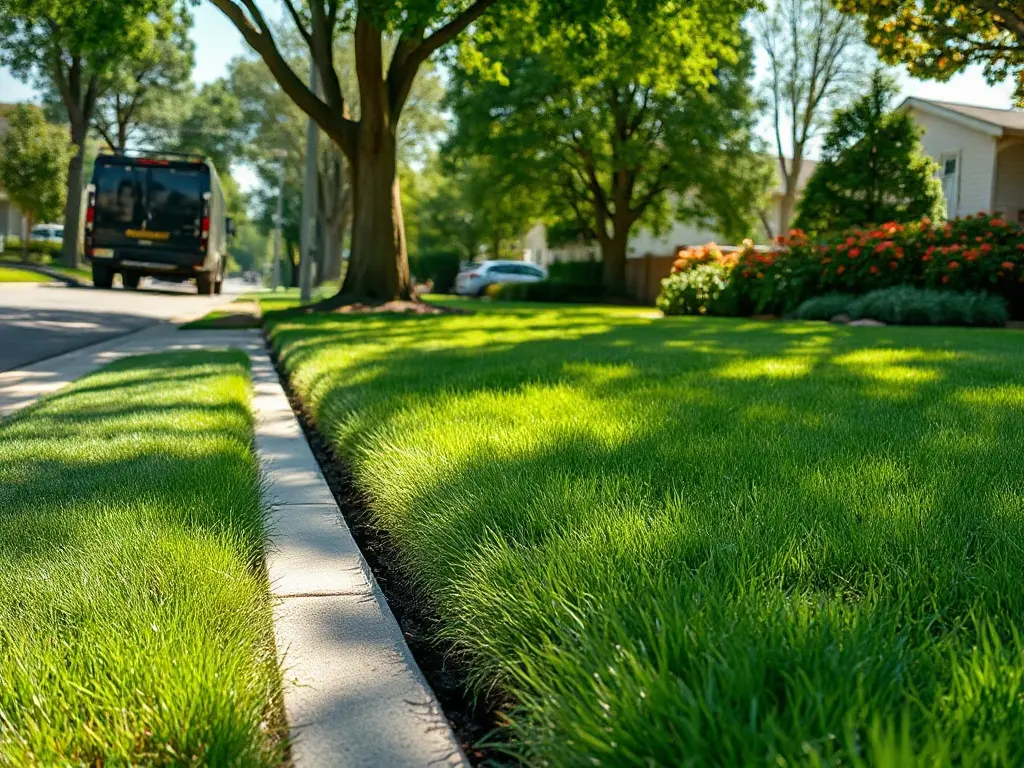
If you want the single fastest way to make more money mowing without buying another truck or working longer days, it's this: get more lawn customers on the same street. A second account four doors down from a customer you already have costs you almost nothing in drive time — you're already parked on that block. That's found money, and most solo operators and small crews leave a pile of it on the table because they chase whatever lead pops up across town instead of working the streets they already own.
This is the definitive guide to doing it on purpose. We'll cover the density math, the exact tactics that stack neighbors onto a route, and how to quote and schedule those clusters so the profit actually shows up.
Why route density is the whole game
Every minute your truck is rolling between jobs is a minute you're not getting paid to mow. That's windshield time, and it's the quiet killer of margin in this business. Route density — how tightly your customers cluster on a street or in a neighborhood — is the lever that kills windshield time. Pack more stops into the same block and you spend more of the day mowing and less of it driving, burning fuel, and idling at lights.
The numbers back this up hard. AAA's long-running Your Driving Costs research pegs the all-in cost of operating a vehicle — fuel, maintenance, depreciation, the works — at well over 20 cents a mile, and that's before you count the labor you're paying a crew to sit in traffic. Cut ten miles of daily driving out of a route and you're clawing back real money every single day, five or six days a week.
The flip side matters too. If your route is scattered, you need higher per-visit pricing just to preserve margin, because your true cost per stop is inflated by all that travel. A tight route lets you stay competitive on price and still keep your profit. Density and pricing are the same conversation.
What good lawn care route density actually looks like
You don't need a theoretical ideal — you need a target. Current lawn-care route-density guidance lands in a consistent range:
- 12–18 properties per day within a 3–5 mile radius for a general residential route.
- 8–12 customers within a half-mile to one-mile radius for tight neighborhood clusters — a useful benchmark for "same street" marketing.
- Around 6 clients on the same street with near-zero drive time between stops. That's the endgame of hyper-local route building.
Six accounts on one street is a beautiful thing. You park once, mow, walk the trailer down, mow the next, and you're done with the block before most operators have finished their first drive of the morning. Treat mowing route density as a KPI you actually track — stops per day and windshield time — not a vague goal.
How do I get customers next door to my current customers?
This is the right question, and the answer is almost always cheaper than buying leads. The best-fit play is simple: work one street hard, then expand to the adjacent streets where your existing customers already live. Your work is visible every week. Neighbors see the stripes, the clean edges, the crew that shows up on time. That standing proof does the selling for you.
Here are the tactics that actually stack neighbors, in rough order of cost-effectiveness.
1. Same-street referrals (cheapest, highest close rate)
The cheapest way to fill an opening in a dense area is to ask the clients already in that neighborhood for referrals. They know their neighbors, they talk over the fence, and a recommendation from someone whose lawn already looks great carries more weight than any door hanger.
Make it worth their while. A cash reward when a neighbor on the same street signs up is a smart spend, because that referral directly builds route density and lowers your fuel cost per stop. A $25 or $50 referral bonus is nothing against a season of near-zero-drive-time revenue. Be specific when you ask: "If any of your neighbors want the same service, send them my way and I'll take $30 off your next mow."
2. Door hangers after every job
When you finish a lawn, the yard is your best billboard. Hang 10–30 door hangers on the nearby houses right then, while your work is fresh and visible. The message writes itself: "We're already mowing on your street today." That line does two jobs — it signals social proof and it tells the neighbor you can add them with zero extra trip.
3. Yard signs with permission
Ask your best customers if you can put a small, tasteful sign in the yard on mow day. Neighbors driving home see who does that lawn. It's passive prospecting that runs while you're at your next stop.
4. Targeted direct mail to nearby homes
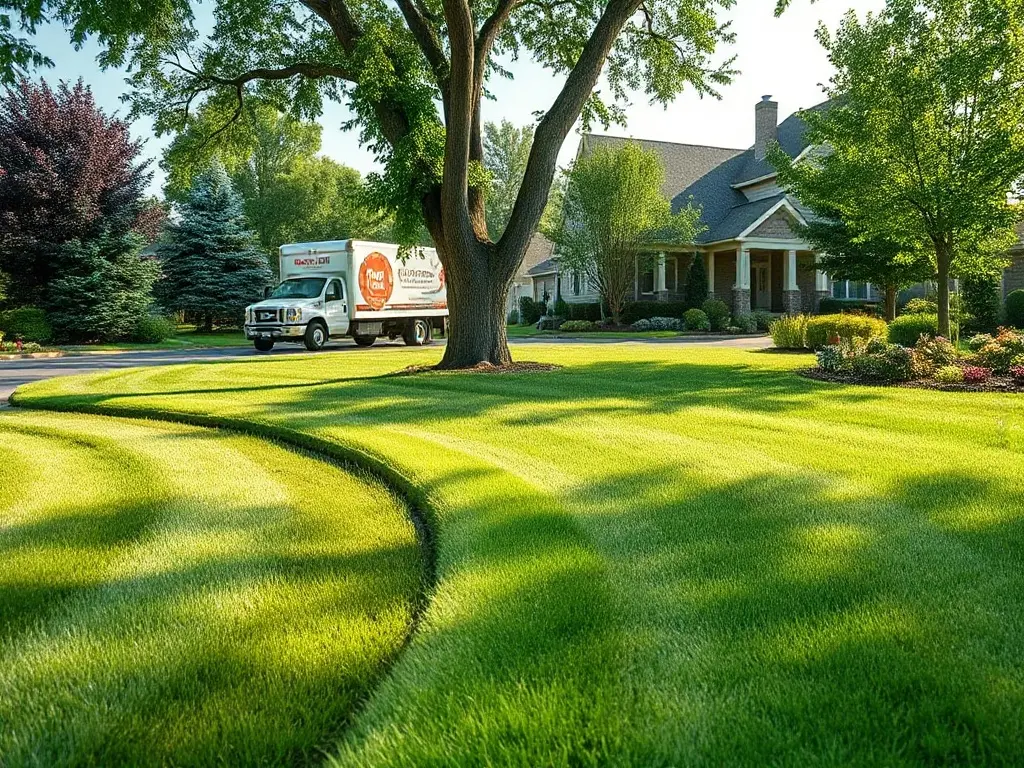
Direct mail still works when it's tight and local. Current neighborhood-marketing guidance suggests drops of roughly 300–1,500 homes nearby, scaled to how dense the area is. The key word is nearby — you're not blanketing the county, you're blanketing the blocks around accounts you already service so every new signup lands on or near an existing route.
A worked example: the density dividend
Let's put real numbers on why this matters. Say you charge $50 per residential mow and you can do a lawn in 25 minutes of actual mowing time.
Scattered route: 12 customers spread across town, averaging 12 minutes of drive time between each. That's 12 × 25 = 300 minutes mowing and 11 × 12 = 132 minutes driving. You've spent 432 minutes to earn $600 — about $83/hour of "on" time, and you burned through a lot of fuel and truck miles getting there.
Dense route: Same 12 customers, but now clustered so drive time between stops averages 3 minutes. That's still 300 minutes mowing but only 33 minutes driving — 333 minutes total. Same $600, but now you're at $108/hour, and you've got roughly 99 minutes of daylight back to add three or four more stops.
Those three extra stops at $50 each are $150 of near-pure profit, because the drive cost is already covered. That's the density dividend: same customers, same price, but tightening the route either hands you an extra $150/day or an hour of your life back. Over a season, that's the difference between grinding and growing.
Build your zones, then feed them
Density isn't a one-time push — it's how you organize the whole operation. Assign each neighborhood zone to a day of the week. Thursdays are the Oakwood subdivision, Fridays are the streets off Route 9, and so on. Then, when a new client comes in, you slot them into the zone that already matches their street. New account on a Thursday street? It goes on the Thursday run, full stop.
This is where your scheduling and client management need to be tight, because a zone system only works if you can see who's where and route the day cleanly. Service Penguin is where I'd run that — it's a field-service platform built for lawn and landscape operators to handle scheduling, jobs, client management, and invoicing, and it's free for solo operators and small crews and scales up to larger operations without you ever having to switch platforms. Keep your zones, your recurring jobs, and your invoicing in one place and the density strategy actually holds together instead of living in your head.
Fill open slots by neighborhood, not by lowest price
Here's the discipline most operators lack: when you've got an open slot, fill it by neighborhood first, not by whoever's the cheapest lead. A nearby customer at your normal rate beats a bargain-hunter across town every time, because the far account eats your margin in drive time before you even drop the deck. Chase the leads that make your existing routes denser.
A lawn care prospecting tool that finds the neighbors for you
Knocking blind is slow. The smarter move is to know exactly which houses sit around your existing accounts and how big each lawn is before you ever hang a flyer. That's what our Find Neighbors feature in Mower Math does — drop a pin on a customer's address and it surfaces every address within a half-mile, so you can see the cluster you're working and target the streets where you already have proof on the ground. As a bonus, because Mower Math measures each lawn from aerial imagery and prices it from your own costs, you can walk up with a ready quote instead of "I'll get back to you" — which is exactly the fast, confident answer that turns a curious neighbor into a signed account.
Prospecting with real square footage in hand also protects your pricing. You're not guessing at a lawn across the street — you know it's 6,800 square feet and you know your number before you knock.
How to get your customer's neighbors as clients: the loop
Put it all together and you've got a repeatable loop:
- Do great, visible work on a street so the proof is standing there every week.
- Ask that customer for same-street neighbor referrals with a small cash reward.
- Hang door hangers on 10–30 nearby homes the day you're there.
- Map the surrounding addresses so you know your targets and their lawn sizes.
- Slot every new signup into the zone and day that already matches their block.
- Repeat on the adjacent street once the first one is dense.
Run that loop street by street and route density stops being luck. You build it on purpose, one block at a time, until your days are mostly mowing and barely any driving.