What's the best prospecting tool for lawn mowing companies that want tighter routes?
The best prospecting tool for lawn mowing companies targets properties next to your existing jobs, not random leads across town. Start by mapping where your current customers already are, measure nearby lawns from aerial imagery, and pitch only homes that fit your service area and minimum price. Density beats raw lead volume because it slashes drive time between stops.
- A prospecting tool should prioritize adjacent properties, because every job you already run is a visible proof point for the neighbors.
- Twenty recurring customers on a tight route can out-earn 40 scattered customers thanks to lower drive time.
- A single recurring mowing account is worth roughly $1,350–$1,950 per season, so even $30–$50 per lead leaves healthy margin.
- Door hangers and EDDM only pay off when neighborhood selection is tight — response rates run 0.5%–3%.
- Measuring lawns from aerial imagery lets you qualify and quote neighbors without a site visit.
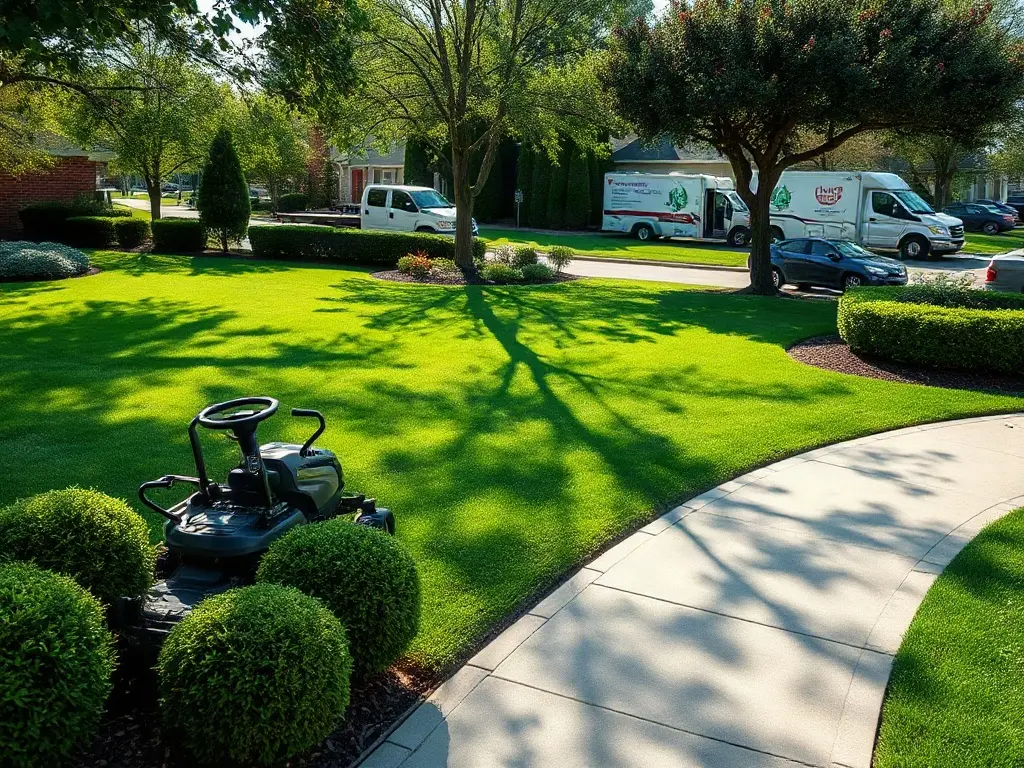
The best prospecting tool for lawn mowing companies isn't a lead list — it's a map of the homes sitting right next to the jobs you already run. Every lawn you mow is a free billboard for the neighbors. The operators who win don't chase volume across the whole county; they stack accounts on the same streets, cut drive time to near zero, and squeeze more revenue out of the same working hours.
The US landscaping market includes roughly 556,000 businesses as of 2026, and it's highly fragmented — which means local density beats broad, untargeted prospecting almost every time. You don't need to out-advertise a national brand. You need to own a few streets.
Why lawn care route density beats raw lead volume
Route density wins because driving doesn't pay. Twenty recurring customers on tight routes can be more profitable than 40 scattered customers, simply because the windshield time is lower. Every minute spent driving between jobs is a minute you can't bill, and fuel and wear pile up on top of it.
Consider two operators with identical revenue. One runs 40 lawns spread across a metro; the other runs 20 lawns clustered on a handful of streets but charges accordingly. The clustered operator finishes earlier, burns less fuel, and can add accounts without adding a second truck. Mowing route density is the quiet lever behind most profitable solo and small-crew operations.
If you're trying to tighten an existing route, our breakdown on how to reduce drive time between mowing jobs pairs directly with the prospecting approach below.
What a real lawn care prospecting tool should do
A real lawn care prospecting tool prioritizes adjacent properties, not just raw lead count. Lead volume tells you how many strangers might call. Density tells you which of those strangers you can service profitably on a route you already drive.
The tool should let you do three things fast:
- See where your customers already cluster so you know which streets to work.
- Identify the specific homes next to those jobs — names and addresses, not a vague "this neighborhood."
- Measure and price those lawns before you ever knock, so you only spend effort on properties that clear your minimum.
That last point matters more than most operators realize. Quoting by measured lawn area helps you avoid underpricing irregular or oversized properties — the kind of mistake that happens when you eyeball street frontage from the cab.
Why measuring from aerial imagery changes the math
Measuring lawns from aerial imagery lets you qualify a whole street without a single site visit. You pull up the block, measure each turf area, and instantly know which homes fit your crew's time and price targets. This is exactly where Mower Math's Find Neighbors earns its keep — it surfaces every address within a half mile of a job you already have, so you can measure, price, and pitch the whole cluster in one sitting. It's free to start.
How to get your customer's neighbors as clients
The fastest way to get your customer's neighbors as clients is to prospect while your truck and trailer are already parked on their street. You're visibly mid-job, the lawn you just finished is the reference, and you've eliminated the drive. The neighbor can watch the quality and see you're reliable enough to show up.
A practical workflow looks like this:
- Identify neighborhoods that already contain customers. One existing account is enough to start.
- Measure the nearby lawns from aerial imagery and filter out anything below your minimum price or outside your service area.
- Contact the fitting properties — a door hanger, a quick knock while you're on-site, or a mailer to the measured list.
Because you already measured, you can hand a neighbor a real number on the spot instead of "I'll get back to you." Speed-to-quote wins jobs, and quoting without a site visit is a big part of why.
How to get more lawn customers on the same street for cheap
Getting more lawn customers on the same street comes down to targeted outreach where you already have a proof point — and the cheap channels only work when the targeting is tight.
Door hangers, priced out honestly
Door hangers commonly cost about $0.30–$1.50 each before labor. At roughly $0.35 a piece, 200 hangers run about $70. With a typical 1%–3% response rate, those 200 pieces produce about 2–6 calls. When response and conversion both land favorably, that's roughly $12–$35 per acquired customer — but only if you drop them on streets where you already mow. Blanket a random subdivision and most of that $70 is gone.
Direct mail and EDDM
USPS Every Door Direct Mail campaigns commonly produce response rates around 0.5%–2%, which makes neighborhood selection and route density the whole game. EDDM lets you mail an entire carrier route cheaply, so it rewards operators who already know which routes contain their customers.
Paid ads, for comparison
Google Local Services Ads commonly run around $20–$50 per lead, and Google Search Ads often land around $15–$45 per lead. Reported lawn-care lead costs swing with the season — roughly $40–$50 in late April and early May, up to the mid-$80s or $90s in summer, and over $200 in winter. Free Google Business Profile visibility can take 30–90 days to build, while paid campaigns can produce leads within days. Paid ads have their place, but they don't naturally build density the way street-level prospecting does.
The crew economics: what a dense street is actually worth
A single recurring mowing customer represents roughly $1,350–$1,950 in seasonal revenue at $55–$75 per cut across 26 visits. Even at the lower end — $45 per cut over a 30-week season — one weekly account produces about $1,350 a year. Mowing frequency drives that visit count, and university turf guidance on mowing height and frequency is a good baseline for how often most residential turf actually needs cutting.
Now run the acquisition math. A $1,350 seasonal account acquired at a $30–$50 lead cost leaves enormous room for marketing spend. Here's a worked example:
You already mow one home on Oak Street. You measure the 11 nearest lawns from aerial imagery, toss 3 that are too small to clear your $45 minimum, and drop 8 door hangers — call it $3 in materials. Two neighbors sign at $50 per cut over 30 weeks. That's about $3,000 in new seasonal revenue for $3 in hangers and maybe 20 minutes of work, and both new stops are on a street you were already driving to.
That's the difference density makes. The same two customers acquired three towns apart would cost you drive time every single week, all season.
How to build route density in lawn care without burning out
Building route density in lawn care is a repeatable loop: land one account in a target neighborhood, prospect its neighbors immediately, then stack the street before moving on. Don't scatter. When one block is full, pick the next closest block to an existing customer and repeat.
As your streets fill up, scheduling gets more complex — more stops per day, tighter sequencing, invoicing to stay on top of. That's where Service Penguin comes in: it handles scheduling, client management, jobs, and invoicing for lawn and landscape operators, it's free for solo operators and small crews, and it scales to larger operations without forcing you to switch platforms later. Build the density with your prospecting; run the dense route with Service Penguin.
One caution on tools in this category: published 2026 pricing for some dedicated or bundled lawn-measurement products runs from about $30 to $75 per month, and commercial aerial takeoff services can start near $10,000 per year. For a solo or small-crew operator building density street by street, a free-to-start measuring tool covers the job without the overhead.
The bottom line on prospecting for tighter routes
The right prospecting tool for lawn mowing companies isn't about finding the most leads — it's about finding the right ones next door. Map where your customers already are, measure the neighbors from aerial imagery, qualify against your minimum, and pitch while you're already on the street. Do that consistently and you build routes that pay more per hour every season.
How many customers do I need on one street to make it worth it?
Even two homes on the same street cuts your cost-per-stop meaningfully, but three to five is where a street starts paying for itself. At that point you can knock out multiple accounts per visit with almost no windshield time, and the route becomes the asset buyers and crews value most.
Are door hangers still worth it for lawn care prospecting?
Yes, when they're targeted. At about $0.35 each, 200 hangers cost roughly $70 before labor, and a 1%–3% response yields 2–6 calls. The economics only work if you drop them on streets where you already have customers — blanketing random subdivisions wastes most of the spend.
What does a lawn-care lead usually cost?
Reported lawn-care average cost per lead sits around $84, with conversion near 5.5% as a directional benchmark. Prices swing hard by season: roughly $40–$50 in late April and early May, mid-$80s to $90s in summer, and over $200 in winter. Channel mix and geography change these numbers materially.
Should I quote neighbors without visiting the property?
For standard residential mowing, yes. Measuring lawn area from aerial imagery gives you square footage accurate enough to price confidently, so you can hand a neighbor a number the same day. Reserve site visits for complex properties, steep slopes, or heavy cleanup where photos can't tell the whole story.
Does route density actually make a mowing business worth more?
Yes. Buyers and lenders value recurring revenue packed into compact geography because it's cheaper to service and easier to transfer. A route where crews run five stops in a mile is far more profitable per hour than one spread across a county, even at the same total revenue.
References
- University guidance on turfgrass mowing frequency and height, which drives the seasonal visit count — University of Georgia Extension