What should a lawn care door hanger say
A lawn care door hanger should say five things: the service you offer, the specific street or neighborhood you're already working, a seasonal reason to act now, one simple call to action, and a phone number plus QR code. Skip the branding-only fluff. "We're mowing your street today — free estimate" beats a generic company pitch every time.
- The highest-converting lawn care door hangers name the service, the street, a seasonal reason, one CTA, and a phone/QR code.
- A "we service your neighborhood today" angle outperforms a generic company-history pitch.
- Plan for 1 lead per 50 to 200 hangers; 100 to 150 hangers typically yields 1 to 3 leads at a 1–2% response.
- Bulk hangers cost roughly $0.09 to $0.25 each, making them one of the cheapest lead sources a solo operator has.
- One clear 'free estimate' CTA beats asking prospects to compare service tiers on the hanger itself.
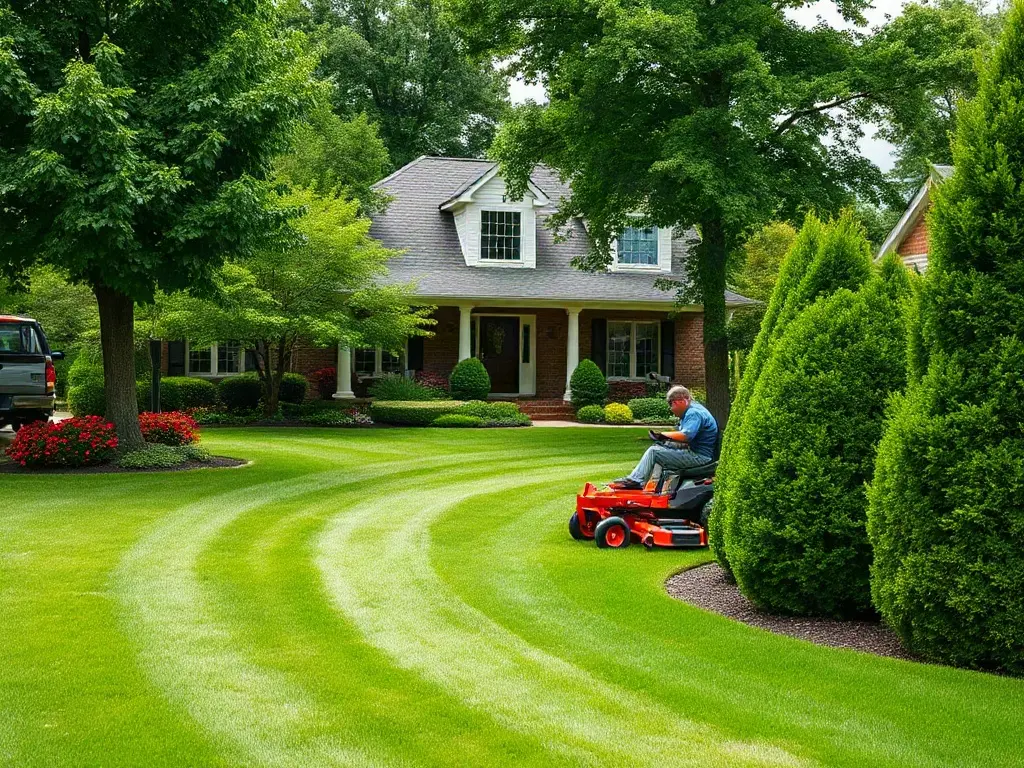
A lawn care door hanger should say five things and nothing more: the service you offer, the specific street or neighborhood you're already working, a seasonal reason to act now, one simple call to action, and a phone number plus a QR code. That's it. "We're mowing your street today — call for a free estimate" pulls better than a hanger that leads with your company name and founding year.
The mistake almost every operator makes with what a lawn care door hanger should say is treating it like a business card. A business card introduces you. A door hanger has to trigger an action from a stranger who's holding it for four seconds before deciding to keep it or trash it. Those are different jobs.
What should a lawn care door hanger say to actually get calls?
The copy that converts follows a direct-response structure, not a branding structure. Local service pros who track their results keep hitting the same five elements:
- The service — "Weekly mowing," not "lawn solutions." Say what you do in plain words.
- The street or neighborhood — "We service [Neighborhood]" or "We're on your street this week." Proximity is the single strongest angle.
- A seasonal reason to act now — "Spring cleanup spots filling up" or "Book before the growing season."
- One call to action — a free estimate. Not three service tiers to compare.
- Phone and QR code — two zero-friction ways to respond.
The most repeated high-performing angle in lawn care is some version of "we're mowing your street today." It works because it signals you're already nearby, which tells the homeowner you're convenient and probably affordable to add to an existing stop.
Why the offer beats the service-menu approach
A single "free estimate" CTA beats listing service levels on the hanger itself. Every extra choice you put in front of a prospect is a chance for them to stall. You don't want a homeowner doing math on their porch — you want them to call or scan so you can measure the lawn and quote it right. Keep the response path to one step.
Do door hangers work for lawn care, or are you wasting paper?
Door hangers work for lawn care, and the response rates are predictable enough to plan around. Industry writeups commonly cite 0.5% to 2%, with some operators reporting 1% to 2% and strong, hyper-local campaigns stretching to 2% to 5%. One reported home-services campaign saw a 1.8% initial response plus 2.7% later redemption for a 4.5% total when the offer was strong and the targeting was tight.
They're also still widely used — one survey summary found 22.5% of respondents naming door hangers as a go-to marketing tool. The economics are hard to beat: bulk hangers run about $0.09 each at high volume, and roughly $0.15 to $0.25 each for simpler printed jobs at lower volume.
What the numbers mean for a solo operator
Plan for 1 lead per 50 to 200 hangers. If you distribute 100 to 150 hangers, a 1–2% response gives you roughly 1 to 3 leads; a strong 3–5% outcome gives you 3 to 8. At $0.09 to $0.25 per hanger, 150 hangers cost you $14 to $38. Land two weekly mowing accounts at $45 each and that campaign pays for itself in the first cut.
Should I hang door hangers near my existing customers?
Yes — hanging near existing customers is the highest-value move you can make, because route density is where lawn care margins live. Adding an account two houses from a current stop costs almost no drive time, so that new customer is more profitable than one across town at the same price. A route-density angle pairs perfectly with the "we service your neighborhood" copy.
Before you print, know exactly which homes to hit. This is where measuring and quoting from Mower Math's Find Neighbors feature earns its keep — it pulls every address within a half mile of a stop from aerial imagery so you can target the tightest cluster instead of blanketing a random subdivision. For a deeper breakdown, we wrote a whole post on hanging door hangers near your existing customers.
When is the best time to hand out lawn care door hangers?
The best time to hand out lawn care door hangers is early spring, when homeowners start thinking about their lawns. Search interest for "lawn care near me" climbs sharply in spring, which makes March offers land while people are actively looking. For cool-season turf, spring is also when mowing ramps back up — University of Minnesota Extension's mowing guidance underscores how fast growth returns once soil warms, so an early hanger catches homeowners right as the work becomes visible.
How often should I hang door hangers on the same street?
Hit the same street two to three times over a season, spaced a few weeks apart, not the same week. Repetition builds recognition, but hammering a street back-to-back annoys people and burns your reputation. A good rhythm: an early-spring drop, a follow-up when your first accounts on that street are visibly getting cut, and a fall cleanup round.
How many hours a week should I spend on lawn care sales?
A solo operator should protect 3 to 5 hours a week for sales year-round, and more in the pre-season ramp. Distributing 100 to 150 hangers takes an hour or two once you've mapped the route. Blocking consistent sales time is how you avoid the winter panic where the phone goes quiet and you're scrambling in April.
Are door hangers or Facebook ads better for lawn care?
Door hangers and Facebook ads solve different problems, and the honest answer is you want both eventually — but door hangers win for a solo operator building route density on a budget. Hangers put you physically in the exact cluster you want to service, with no ad-platform learning curve and a hard cost of pennies per home. Facebook ads reach wider but scatter you across a whole metro, which fights the drive-time math. Start with hangers on tight streets; layer in ads once you can afford leads that aren't next door.
Turning door hanger leads into booked jobs
The hanger only earns its keep if you convert the call fast. When a lead scans your QR code or dials your number, you want to quote quickly and accurately without a windshield tour of the neighborhood. Measuring the lawn from aerial imagery and pricing it from your own costs means you can text back a real number the same day — which matters, because a fast free-estimate turnaround is what closes the direct-response leads a good hanger generates.
Should a door hanger list prices or just offer a free estimate?
Offer a free estimate. Listing prices on a hanger invites comparison shopping and gives strangers a number before you've measured their lawn. A single "free estimate" or "free quote" CTA keeps the response path simple and gets them to call or scan instead of doing math on their porch.
What size and format works best for a lawn care door hanger?
A standard 4.25" x 11" hanger with a die-cut door hole is the norm and prints cheaply in bulk. Keep one dominant headline, one offer, and one CTA on the front. Use the back for a QR code and a short bulleted list of services so the front stays uncluttered and readable from arm's length.
Do I need a QR code on a lawn care door hanger?
Yes. A QR code that links to a quote-request page or your phone gives prospects a zero-friction way to respond without typing. Many homeowners will scan instead of call. Point it at a neighborhood-specific page or an estimate form, not just your homepage, so the visit converts.
How do I know if my door hangers are working?
Track responses by campaign. Use a distinct QR code, a coupon code, or ask "how'd you hear about us" when they call. If you hang 150 and get two calls, that's a 1.3% response — right in the normal range. Test one variable at a time: headline, offer, or neighborhood.
References
- Spring lawn care and mowing timing for cool-season turf — University of Minnesota Extension