How often should I hang door hangers on the same street?
Hit the same street in short bursts during peak season — roughly every 2 to 6 weeks, not year-round. A common cadence is 2–3 weekly touches to launch, then a repeat drop every 4–6 weeks while people are shopping. Repeating the same homes about 3 times, 10–15 days apart, is also cited. Test response by neighborhood instead of assuming one fixed interval.
- Door hangers work best as seasonal bursts, not constant saturation.
- A practical repeat cadence is every 4–6 weeks during peak season on the same street.
- Repeating the same homes about 3 times, 10–15 days apart, is a common tactic.
- Expect roughly 0.5%–2% response on lawn-care door hangers as a baseline.
- Hang hangers where you already mow so route time stays near zero.
Hang door hangers on the same street in short bursts during peak season — roughly every 2 to 6 weeks — not year-round. A practical launch cadence is 2–3 weekly touches, then a repeat drop every 4–6 weeks while homeowners are actively shopping. Another common tactic is repeating the same homes about 3 times with 10–15 days between drops. The interval isn't sacred: test response by neighborhood and weather instead of locking to one universal number.
The mistake most solos make is treating hangers like a one-and-done. One drop rarely lands because the homeowner has to see your name at the exact moment they're annoyed at their lawn. Bursts catch more of those moments without burning your route time.
How often should you hang door hangers on the same street?
Repeat the same street every 4–6 weeks during the mowing season to stay top-of-mind without overmailing. That window is drawn from contractor direct-mail guidance, and it holds up for lawn care: often enough to catch a homeowner right when they decide to hire out, spaced enough that you don't read as spam.
If you'd rather run a tight launch, start with 2–3 consecutive weekly touches on the same homes, then adjust based on what actually calls. Some lawn-care marketers push the same hanger 3 times per home with 10–15 days between drops. Both approaches beat a single scatter.
The honest read for 2026: hit the same street in bursts every 2–6 weeks during peak season, then let response data — not a rule of thumb — set your real interval. A street that ignores three drops isn't your street. Move the batch.
Do door hangers work for lawn care?
Yes, but as a supplemental local tactic — they work best when you're already servicing the street and can reuse the route for repeat touches. Baseline response for lawn-care door hangers commonly runs 0.5%–2%. Some marketers claim 2%–5%, but treat that as a best-case number, not what you should budget around.
Run the math before you print. At 100–150 hangers per outing and a conservative 1% response, you're looking at 1–2 leads per batch. Hang three batches on the same cluster over a season and the compounding exposure is where hangers start earning their keep. For a deeper breakdown, see our post on whether door hangers work for lawn care and the real math.
When is the best time to hand out lawn care door hangers?
The best time is right before and during spring green-up, when homeowners first look at their yards and decide whether to handle it or hire it out. Direct-mail guidance for lawn care leans on 1–2 well-timed touches at the exact moment people are shopping over constant year-round saturation.
Watch your turf's growth calendar, not just the date. Cool-season lawns wake up and demand attention on their own schedule — NC State Extension's lawn maintenance resources lay out when growth ramps in different regions. Drop your first burst two to three weeks before that ramp so you're on the porch when the grass gets embarrassing. A second burst mid-season catches the homeowners who tried DIY and quit.
Should you hang door hangers near your existing customers?
Absolutely — your own street and the 3–4 blocks around a current customer are the highest-return hangers you'll ever place. You're already parked there, your equipment is running, and neighbors can literally see the fresh stripes on the yard next door. Route time stays near zero, which is the whole game.
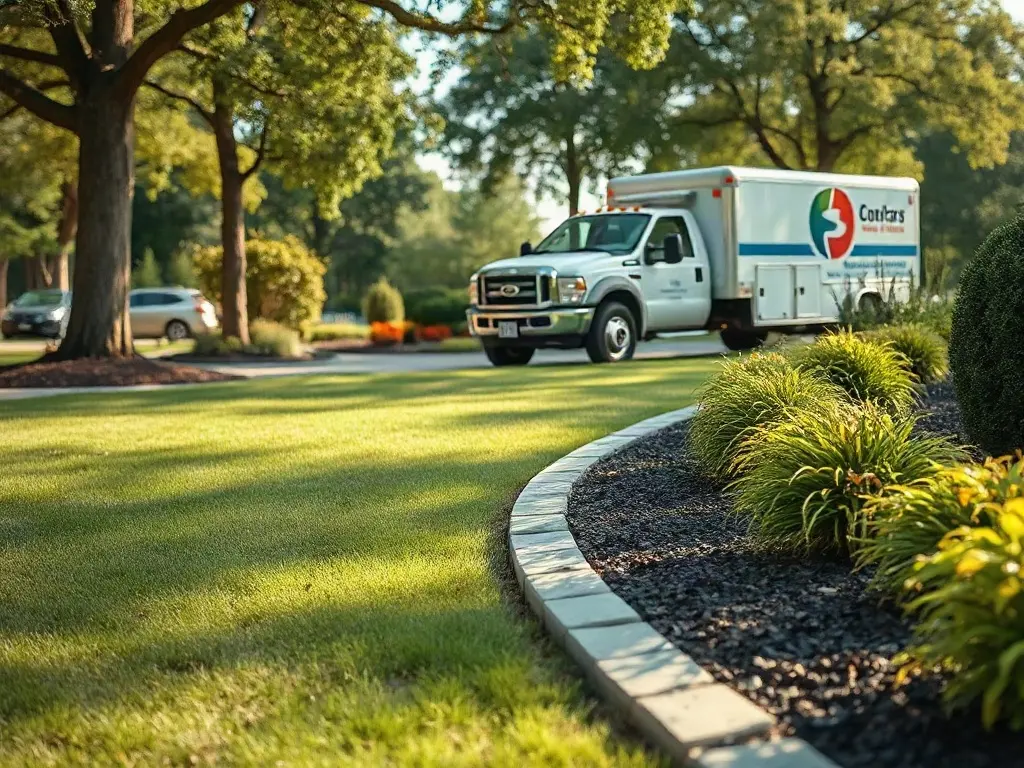
Density is what turns hangers into profit. Two lawns on the same street beat two lawns 15 minutes apart every time, because drive time between jobs is unpaid. Our breakdown of whether drive time belongs in a lawn quote shows exactly how much scattered stops cost you.
Before you walk a block, it helps to know which addresses are worth quoting. Mower Math can measure and price the nearby lawns from aerial imagery, and its Find Neighbors feature lists every address within a half mile — so you hang hangers on the densest routes instead of guessing. Knowing the lot size and your own price before you knock means you can put a real number on the hanger.
What a worked example looks like
Say you mow one lawn on Oak Street and you cluster-hang 120 hangers over the surrounding 4 blocks. At a conservative 1% response you get about 1 lead per drop. Run three drops across the season, 4–6 weeks apart, and you're realistically looking at 2–3 new clients on one street.
Now the economics: those clients sit on a route you already drive. If each pays $45 a cut, 26 cuts a season, three new Oak Street clients add roughly $3,500 in revenue with almost no added windshield time. That's the payoff of tight cadence on a street you already service.
Are door hangers or Facebook ads better for lawn care?
They solve different problems, so "better" depends on your goal. Door hangers win when you want route density on a specific street — you control the exact block and your leads land where you already mow. Facebook ads win on reach and retargeting across a wider service area, useful when you're expanding into new neighborhoods.
For a solo or small crew tightening a compact route, hangers usually produce cheaper, closer leads because there's no ad spend and no competing against every other advertiser in the feed. Run both if you can afford it, but if you're picking one, start with hangers on the streets you already service.
How many hours a week should you spend on lawn care sales?
Block a steady 2–4 hours a week on sales rather than binge-selling when work dries up. Split that across hanging a batch, following up on calls the same day, and measuring and pricing nearby lawns so you're ready to quote fast. Consistency wins: a street that sees you three times over six weeks converts far better than one giant one-time push.
Once those leads start calling, you need somewhere to put them. Service Penguin handles the scheduling, client records, jobs, and invoicing — it's free for solo operators and small crews and scales up without making you switch platforms later. Get your follow-up and booking dialed in before the hangers land, so a hot lead doesn't sit in a text thread and go cold.
The bottom line on door hanger cadence
Hang the same street in bursts every 2–6 weeks during peak season, concentrate around lawns you already mow, and let response — not a fixed rule — tell you when to repeat or move on. Time your first burst to spring green-up, keep the hanger to one offer and one contact, and track which streets actually call. That's how door hangers stop being a shot in the dark and start building a tight, profitable route.
How many door hangers should I hang in one outing?
Plan for 100–150 hangers per outing as a realistic solo target. At a 3%–5% response assumption that yields about 3–7 leads, though many operators see closer to 0.5%–2% in the real world. Cluster them tight so you're walking a few blocks, not driving between drops, and your cost per lead stays low.
Should I hang door hangers near my existing customers?
Yes. Hitting your own street and the 3–4 blocks around it while you're already servicing the route is the highest-ROI move. Your truck and trailer are visible, neighbors already see your work, and your drive time is basically zero. Route density like this raises revenue per hour more than chasing scattered leads across town.
What should a lawn care door hanger say?
Keep it to one offer, one benefit, and one way to reach you. Lead with a specific hook ("Mowing your street this season"), name the service, give a price range or first-cut offer, and put a phone number and QR code big enough to read from the porch. Skip the paragraph of copy — hangers get a two-second glance.
Are door hangers or Facebook ads better for lawn care?
They do different jobs. Door hangers win for tight route density — you choose the exact street you already mow. Facebook ads win for reach and retargeting across a wider area. For a solo or small crew building a compact route, hangers usually deliver cheaper, closer leads. Run both if budget allows, but start hangers where you already work.
How many hours a week should I spend on lawn care sales?
Block a consistent few hours weekly rather than binge-selling when work slows. Two to four focused hours — hanging a batch, following up on calls, and measuring nearby lawns — keeps the pipeline full without eating mowing time. Consistency beats intensity; a street that sees you three times converts better than one big one-time push.
References
- Seasonal lawn care timing and when homeowners start shopping for services — NC State Extension TurfFiles