How Do I Price a Lawn From Just the Address?
The fast, defensible way to price a lawn from just the address: measure the turf from aerial imagery, subtract the non-mowable stuff, apply your own per-square-foot rate, then adjust for edges and obstacles.
Here's the short answer to "how do i price a lawn from just the address?" Pull up the property on aerial imagery, outline and measure only the mowable turf, subtract driveways, the house footprint, beds, and any other non-grass surfaces, then multiply the remaining square footage by your own labor-and-overhead-based rate per square foot. Add line items for edging, obstacles, and how often you'll be there. You can do all of that from your truck in a couple of minutes — no site visit, no callback.
That's the whole game. The rest of this post is about doing it accurately enough that you're not giving away work or scaring off good leads with a number you pulled out of the air.
How do I price a lawn from just the address, step by step
The workflow is the same whether you run one truck or three:
- Start with the address. The address is what unlocks aerial imagery and measurement. Type it in, and you're looking down at the property.
- Measure the mowable turf. Outline the actual grass. This is the number that matters — not the parcel size, not the lot the county lists.
- Subtract everything that isn't grass. Driveway, house, patio, pool, mulch beds, gravel. "Address-only" pricing goes wrong when people quote off lot size instead of mowing area.
- Apply your rate per square foot. This is your cost of labor and overhead built into a per-sq-ft number, not a guess.
- Add adjustments. Edging, string-trimming around obstacles, slopes, gates, and frequency all move the price.
Notice that measuring the turf is the load-bearing step. Parcel size can be double the mowable area on a lot with a big house and long driveway, so pricing off the address alone — without measuring — is how you lose money.
What's the app that measures yards from satellite?
You don't need to eyeball anything. Address-based measurement tools let you outline the lawn on aerial imagery, auto-calculate the square footage, and then set a per-square-foot rate to spit out a quote. This is exactly what Mower Math does: enter any address, measure the lawn from aerial imagery, and price it from your own costs. No tape wheel, no walking the property before you've even won the job.
If you want to sanity-check the imagery approach or you're coming from a Google Earth habit, we broke down the limits of that in Can You Measure a Lawn With Google Earth? — the short version is that a purpose-built tool saves you the manual math and the second-guessing.
How do I quote a lawn from my truck?
Same steps, phone screen instead of a laptop. A lead comes in at 8:10 a.m., you're between stops, you open the address, measure the turf, and send a price before the customer has finished texting three other companies. That speed wins jobs — leads go cold fast, and the operator who answers first usually books the work. We go deeper on that in the speed-to-lead guide, but the takeaway is simple: being able to measure a lawn before you drive out there means you can quote everything, not just the addresses that happen to be on your way home.
What rate per square foot should I use?
Your rate should come from your numbers — crew wage, drive time, fuel, equipment wear, and the margin you need. But you want benchmarks so you know if you're in the ballpark.
Some lawn-care training material uses a rough beginner rule of thumb of about $100 per acre as a starting point. Others cite a going-rate range of roughly $0.20 to $0.35 per 100 sq ft for mowing, which works out to about $87 to $152 per acre before add-ons. Treat those as guardrails, not gospel — they're heuristics, and your market may run higher or lower.
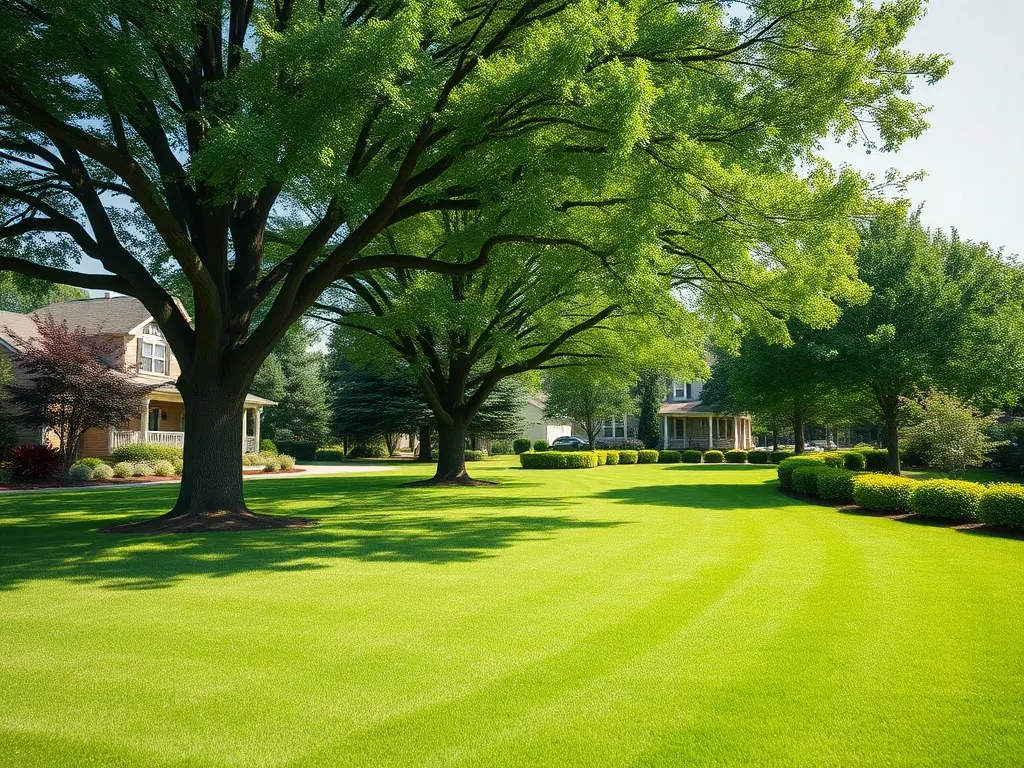
Keep in mind that mowing height and frequency affect how the turf actually performs, which is part of what you're selling. Cool-season lawns generally want to be mowed at around 3 to 4 inches and never scalped by more than a third at a time, per Michigan State University Extension's mowing guidance. That matters when a customer asks why you won't mow their heat-stressed lawn to the dirt — and it justifies a proper recurring schedule over a one-and-done cut.
A worked example
Say a lead comes in. You measure from the address and get:
- Total lot: 12,000 sq ft
- House footprint + driveway + patio: 4,200 sq ft
- Mulch beds: 800 sq ft
- Mowable turf: 7,000 sq ft
Your rate, built from your costs, is $0.28 per 100 sq ft. That's 70 × $0.28 = $19.60 for the mow. Too low to bother? Right — because that's just the mow. Now add your edging rate (say $12 for the driveway and walk perimeter), a $5 obstacle bump for a fenced backyard and a trampoline, and you're at about $37 per visit. On a weekly schedule at 28 visits a season, that's roughly $1,036 a year from one lawn you never had to drive to for a quote.
That's the power of breaking the price into unit pricing — measured turf, plus edging, plus adjustments — instead of throwing out one flat number and hoping. It also gives you something defensible when a customer pushes back.
The tool to see all my customers' neighbors
Once you can price from the address, the next lever is route density. Two lawns on the same street are worth far more per hour than two lawns 15 minutes apart, because windshield time is dead time you can't bill. That's why quoting tools are increasingly paired with neighbor-finding — Mower Math's Find Neighbors shows you every address within a half mile of a job you already have, so you can knock or mail the cluster and tighten the route. If you want the full breakdown of why this matters to your bottom line, read Mowing Route Density: The Complete Guide.
After the quote: scheduling and invoicing
Pricing from the address wins you the job. Keeping it organized is a separate layer. Once you're booking recurring work, you need somewhere to schedule visits, track clients, and send invoices without cobbling together a notebook and a spreadsheet. Service Penguin handles that side — scheduling, jobs, client management, and invoicing — and it's free for solo operators and small crews, scaling up as you add trucks without making you switch platforms later.
The bottom line
The fastest defensible answer to "how do i price a lawn from just the address" is to measure the turf from aerial imagery, subtract the non-mowable space, apply your own per-square-foot rate, then add for edges, obstacles, and frequency. The market has moved from "call for estimate" to instant, address-based quotes because customers get a price immediately and you respond before the lead cools. Get good at this and you'll quote more lawns in less time — and only drive to the ones you've already won.