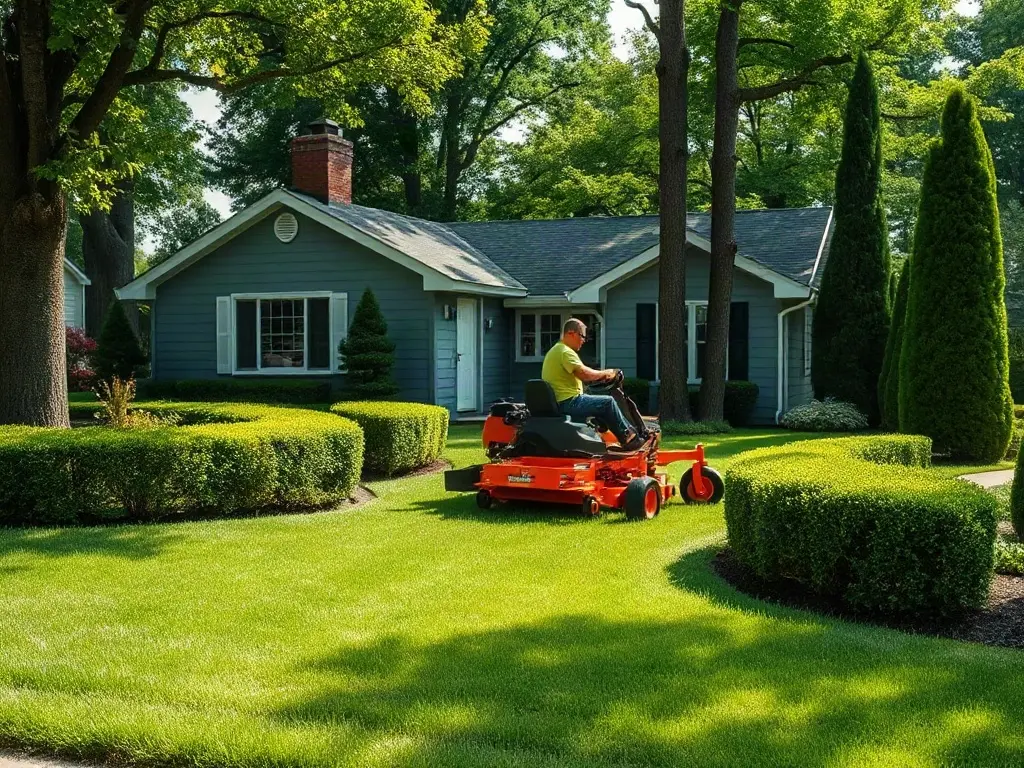
How do I start a lawn mowing business in 2026?
Start a lawn mowing business in 2026 by launching lean: you can begin for $300–$1,360 with used gear and no truck, or budget $5,000–$8,000 for commercial equipment before a vehicle. Register an LLC, carry general liability insurance, price mows at $45–$90 per visit, and win your first customers by measuring and quoting fast without a site visit.
- A no-truck lawn mowing launch can cost as little as $755–$1,360 in 2026, versus about $30,000–$35,000 if you buy a truck upfront.
- Mowing is the most profitable recurring lawn service because it repeats weekly and fills a tight, dense route.
- U.S. mowing rates in 2026 commonly run $45–$90 per visit, with hourly work around $45–$80.
- Route density, not raw customer count, drives your real profit margin.
- Most solo operators need roughly 40–60 recurring accounts to run a full-time weekly route.
You can start a lawn mowing business in 2026 for as little as $300–$1,360 if you already own basic gear or buy used and skip the truck. That's the honest floor. A more typical used-equipment solo launch runs $3,000–$10,000, and a full truck-and-commercial-gear build runs $15,000–$50,000 or more. The gap between those numbers is almost entirely the vehicle — so the first real decision is whether you start with the truck you already have.
What it actually costs to start a lawn mowing business in 2026
The single biggest cost in starting a lawn mowing business in 2026 is the truck. One 2026 estimate puts a no-truck start at $755–$1,360 minimum, versus about $30,000–$35,000 if you buy the truck upfront. If you own a usable vehicle, you skip the largest line item entirely.
Equipment is the next block. A residential-ready kit — commercial mower, trimmer, blower, edger, and safety gear — commonly runs $2,650–$6,700 in 2026. A new-equipment solo setup before a truck is often budgeted at $5,000–$8,000; a "standard" commercial-ready solo start lands closer to $7,000–$17,000 when a truck already exists.
Don't skip the boring line items. In 2026, expect LLC and state fees of $50–$500, general liability insurance around $450–$870 in year one, and equipment insurance of $155–$500. If you add a truck, commercial auto insurance runs $2,000–$2,500. Marketing — website, cards, door hangers, yard signs — runs $200–$1,500, and consumables like fuel cans, trimmer line, and blades run a modest $100–$200.
A two-person crew is a different animal. 2026 startup guidance for a two-person crew commonly lands at $20,000–$35,000, mostly from the added trailer, equipment, and vehicle.
A worked example: the $1,900 solo launch
Say you own a pickup and start lean. Used commercial 48" mower off a retiring operator: $1,100. Trimmer, blower, edger used: $450. LLC filing: $150. Cards and 500 door hangers: $150. Fuel cans, line, spare blade: $75. You're on lawns for under $1,925 — insurance added the following week once the first checks clear. At $50 a mow, that setup pays for itself in about 39 cuts.
Why mowing is the most profitable lawn service to start with
Mowing is the most profitable lawn service to build a business on because it repeats every 5–7 days and clusters geographically. Every visit is another invoice from the same address, and once you're on the property you can upsell fertilization, aeration, and cleanups without spending a dime to acquire that customer again.
The math is simple. U.S. mowing pricing in 2026 commonly runs $45–$90 per visit, with hourly rates around $45–$80. One 2026 pricing guide puts standard mows at $35–$55 for lots under 1/4 acre, $45–$75 for 1/4–1/2 acre, $65–$110 for 1/2–1 acre, and $90–$170 for 1–2 acres. Fill a day with 15 tight quarter-acre lots at $45 and you've billed $675 before lunch is a bad day.
Cutting at the right height keeps turf dense and repeat customers happy — Clemson Cooperative Extension's guidance on mowing height and frequency is worth reading before you set your deck. Scalped, stressed lawns lose you accounts faster than any price hike.
How to get lawn mowing customers fast in your first season
The fastest way to get lawn mowing customers is to work one neighborhood hard instead of chasing scattered leads across town. Density beats volume. Door hangers on a single street, a yard sign at every job, and a same-day quote will out-perform a broad Facebook blast almost every time.
Speed to quote is the quiet edge. Most operators still drive out to measure before they price — which means the homeowner waits days. If you can measure the lawn from aerial imagery and send a branded estimate the same hour they call, you close before the competition schedules a visit. That's exactly what Mower Math does: measure any address and price it from your own costs without leaving the truck.
To pack the route while you're at it, the Find Neighbors feature lists every address within a half mile of a job you already have — so your next ten quotes are on the same street you're already parked on.
Lawn mowing business profit margins and how many customers you need
A well-run solo mowing operation targets net profit margins in the 20–35% range once equipment, fuel, and insurance are covered — and route density is the biggest lever on that number. Two operators charging the same rate can have wildly different margins purely because one drives 8 minutes between stops and the other drives 25.
How many customers does a lawn business need? A full-time solo operator typically needs roughly 40–60 recurring weekly accounts to fill a route, depending on lot size and how tight the neighborhoods are. Fewer large properties or more small ones shifts the number, but 50 is a useful anchor.
How to grow a mowing route from 20 to 100 customers
Grow a mowing route from 20 to 100 customers by densifying before you expand — fill every street you already touch before adding a new ZIP code. Every new account within a half mile of existing work adds revenue without adding drive time, so your margin climbs as you grow instead of eroding.
Around the 40–50 account mark, spreadsheets and text threads stop working. That's when scheduling, routing, and invoicing need a real system. We cover the tipping point in do I need field service software at 50 accounts. For scheduling, client management, jobs, invoicing, and CRM, use Service Penguin — it's free for solo operators and small crews and scales to larger operations without switching platforms later.
The most profitable services to add after you're rolling
The most profitable services for a lawn care business to add after mowing are recurring, prepaid, and low-labor per visit: fertilization and weed-control programs, aeration, and seasonal leaf cleanups. They stack margin onto customers you already serve, and they smooth out the revenue dips at the shoulders of the mowing season.
Add them in order of demand on your existing route. If half your accounts have thinning turf, a fert program sells itself the next time you're on the property. The mowing relationship is the sales channel — that's why you anchor the business on it first.
Your first 30 days, in order
- Register the LLC and open a business bank account ($50–$500).
- Buy used commercial gear if you can — mower, trimmer, blower, edger.
- Bind general liability and equipment insurance before your first paid job.
- Pick ONE target neighborhood and measure/quote every home you can.
- Door-hang the street, plant a yard sign at your first job, and ask for referrals.
Start narrow, price from your real costs, and keep the route tight. That's how you build a mowing business in 2026 that's profitable from the first full week — not the second season.
How much money do I need to start a lawn mowing business in 2026?
You can start for $300–$1,360 in 2026 if you already own or buy used gear and skip the truck. A typical used-equipment solo launch runs $3,000–$10,000, and a full truck-and-commercial-gear build runs $15,000–$50,000+. The truck is the single biggest cost jump — a no-truck start versus a truck-included start is the difference between roughly $1,000 and $30,000.
Do I need an LLC and insurance to mow lawns?
Yes, get both before you take paying work. In 2026, LLC and state registration fees commonly run $50–$500, general liability insurance runs about $450–$870 in your first year, and equipment insurance runs $155–$500. If you add a truck, commercial auto insurance runs $2,000–$2,500. Skipping coverage risks your personal assets over one thrown rock or property damage claim.
How many lawns can one person mow in a day?
A solo operator on a tight route realistically mows 12–20 residential lawns a day, depending on lot size, drive time, and equipment. Small quarter-acre lots at $35–$55 each go fast; half-acre-plus properties at $65–$110 take longer. Route density is the limiter — cutting drive time between stops is what lets you hit the high end of that range.
What's the most profitable service to add after mowing?
Fertilization and weed-control programs are the most profitable add-on because they're prepaid, recurring, and low-labor per visit. Aeration and leaf cleanup carry strong seasonal margins too. But mowing stays the anchor — it puts you on the property weekly, which is how you upsell everything else without paying to acquire a new customer.
References
- University guidance on proper mowing height and frequency for healthy turf — Clemson Cooperative Extension (Home & Garden Information Center)