How do I quote lawns from my phone without driving to every property?
Pull up the address, measure the mowable turf from aerial imagery, record turf and hardscape separately, apply your own cost-based rate per 1,000 square feet, and add a minimum charge that covers load-in, drive, and cleanup. Send it as a conditional quote, then confirm access, slope, and gates before the first cut.
- You can quote most residential lawns from your phone by measuring mowable turf from aerial imagery instead of driving a sales route.
- Price the mowable turf area only—exclude the house, driveway, beds, and pool—then apply your own cost per 1,000 square feet.
- A minimum charge is non-negotiable because load-in, travel, and setup take almost as long on a small lawn as a big one.
- Direct labor eats 38%–45% of maintenance revenue, so underpricing a phone quote by a few dollars a visit guts your margin.
- Treat remote measurements as estimates and send a conditional quote until you confirm access, slope, and grass height on arrival.
You can quote most residential lawns from your phone in a few minutes: pull up the address, measure the mowable turf from aerial imagery, apply your own cost-based rate per 1,000 square feet, add a minimum charge, and send it. No windshield sales drive, no fuel burned to lose a bid. Learning how to quote lawns from your phone is the single fastest way a solo operator or small crew can turn more leads into scheduled work without adding hours to the day.
Here's the full workflow, the math behind it, and the traps that will quietly cost you margin if you skip them.
Why phone quoting beats the sales drive for most lawns
A phone-based quote avoids a dedicated sales trip whenever aerial imagery gives you a usable view of the property. You measure the turf remotely, then confirm access, slope, gates, obstacles, and grass height before or during the first service. For the typical open suburban lot, the imagery tells you almost everything you need to set a fair price.
The economics are brutal on the old way. A sales drive costs you fuel, an hour of drive-and-measure time, and the opportunity cost of a mowing stop you didn't run. Quote ten leads by truck and you might land three. Quote ten from your phone and you've spent 30 minutes total—then you drive only to the jobs you actually won.
When you should still verify in person
Treat aerial measurements as estimates when tree canopy, outdated imagery, steep slopes, fencing, or unusual access limits what you can see. Backyards hidden under mature trees, properties on a grade, and anything behind a locked gate deserve a look before you commit to a firm number. The phone quote still gets you in the door—you just flag it as conditional.
How to measure mowable turf from aerial imagery
Measure the mowable turf area, not the parcel or lot size. Exclude the house footprint, driveway, patios, pool, beds, and unusable slopes unless they create separate billable work. A half-acre lot with a big house and a pool might have less grass to cut than a quarter-acre lot that's wall-to-wall turf—lot size alone will lie to you every time.
Good aerial-measurement separates turf, beds, driveways, and other hardscape so each area can carry a different service rate. That matters because mowing, bed maintenance, and edging along hardscape are different work at different prices. Record them separately from the start and your quotes stay honest as you add services.
This measure-and-quote layer is exactly what Mower Math is built for: enter an address, measure the turf from aerial imagery, price it from your own operating costs, and use Find Neighbors to spot nearby properties for denser routes. It's free to start, which makes it an easy way to test a phone workflow before you commit to one.
The lawn mowing quote calculator math that actually holds up
The core formula is simple: measured mowable area × your price per 1,000 square feet, subject to a minimum charge. Any lawn mowing quote calculator worth using runs on that logic. The part people get wrong is the rate and the minimum—not the measurement.
Quote from your own production economics, not a competitor's per-lawn price. Build your rate from labor, payroll burden, fuel, maintenance, equipment replacement, insurance, overhead, travel, and the profit you actually want to keep. Landscaping and groundskeeping labor averages about $19.13 per hour—roughly $39,790 a year—in the latest industry figures, and that's just the base wage before you load payroll taxes and workers' comp on top.
Those numbers aren't trivia. Direct labor—wages, payroll taxes, and workers' comp—typically consumes 38% to 45% of maintenance revenue, and equipment plus depreciation adds another 7% to 10%. When labor alone eats close to half your revenue, underpricing a quote by a few dollars a visit materially shrinks what's left for you.
Why a minimum charge is non-negotiable
Fixed stop time is why a minimum charge makes or breaks a phone quote. Loading, travel, unloading, and setup can take nearly as long on a small lawn as on a much larger one. If you price purely by square foot, a tiny lawn can look like a $12 job on paper while it actually ties up 30 minutes of your day.
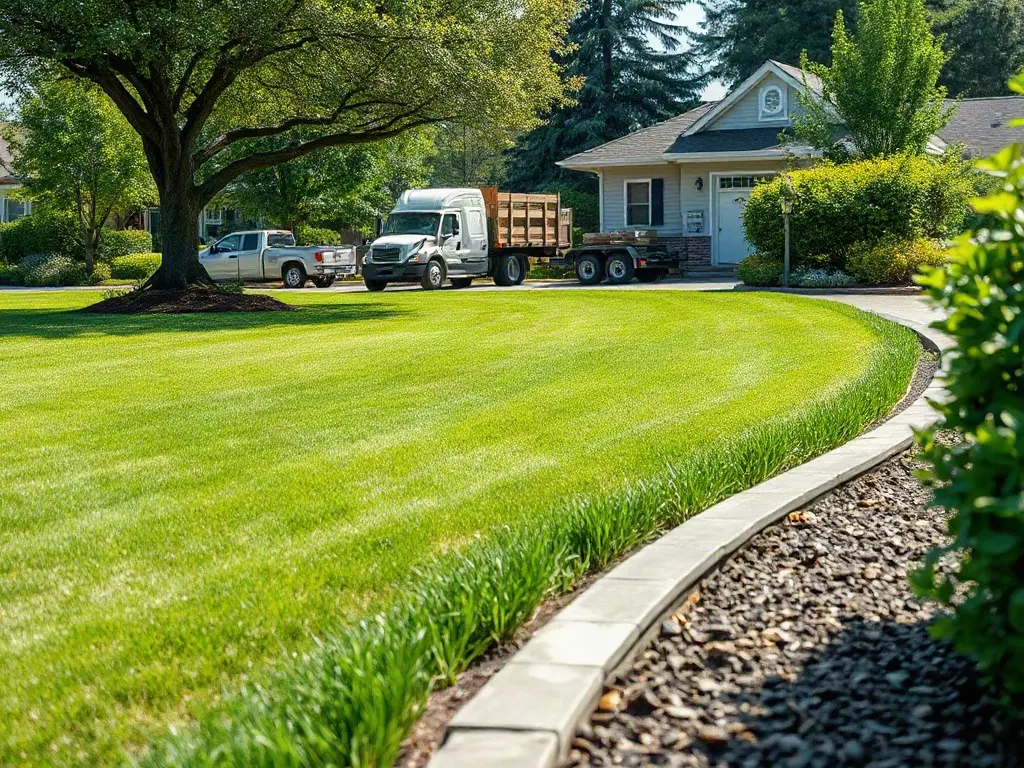
Set a minimum that covers loading, driving, unloading, mowing, trimming, edging, and cleanup for your smallest profitable stop. Then your per-1,000-square-foot rate only takes over once the lawn is big enough to clear that floor. This is the single most common reason new operators quote fast and still go broke.
A worked example: quoting a real lawn in two minutes
Say you measure a property and the aerial read gives you 6,800 square feet of mowable turf after you subtract the house, driveway, and beds. Your cost-based rate is $7 per 1,000 square feet of turf, and your minimum stop charge is $45.
- Turf math: 6.8 × $7 = $47.60
- Minimum check: $47.60 is above your $45 floor, so the turf price stands.
- Quoted price: round to $48 per visit.
Now a second lawn measures 3,200 square feet of turf. The math gives 3.2 × $7 = $22.40—well below your $45 minimum. You quote $45, because the fixed load, drive, and setup time on that small stop is nearly the same as the bigger one. Skip the minimum and you just agreed to mow for roughly half your real cost.
Notice how fast that is. Two addresses, two measurements, two numbers—under five minutes total, and both prices are built from your costs, not a guess.
Building a repeatable lawn quoting tool workflow
A reliable phone quoting process follows the same five steps every time, which is what makes it a real lawn quoting tool instead of a one-off guess:
- Collect the address from the lead.
- Measure the lawn from aerial imagery—turf first.
- Record turf and hardscape separately so each can carry its own rate.
- Apply your own cost-based rate per 1,000 square feet and add your minimum.
- Send the quote before you schedule anything.
Repeatability is the point. When every quote runs the same path, you stop improvising prices under pressure and your margins stop drifting. For a deeper look at standing up this process from scratch, our guide on measuring and quoting lawns walks through the setup.
Pricing by square foot, acre, or minimum visit
Remote measurement lets you price by square foot, thousand square feet, acre, or minimum visit charge rather than leaning on lot size. Pick the unit that matches your market. Most residential operators price per 1,000 square feet with a minimum; larger properties and estates often price per acre once mowing becomes the dominant cost and fixed stop time shrinks as a share of the job.
Grass type and cutting frequency also shape the real cost of a route, since some lawns need more frequent mowing to stay within healthy height limits. Rutgers' extension program publishes clear mowing and turf maintenance guidance on cutting heights and frequency that's worth knowing when you set a season-long schedule, because a lawn that needs an extra cut per month changes the math on an annual quote.
How to frame an instant lawn quote without getting burned
Send an instant lawn quote as conditional, not carved in stone. A clean way to phrase it: "Based on approximately X square feet of mowable turf; final price may change if access, slope, obstacles, or lawn condition differ on arrival." That one sentence protects you from the handful of properties where the imagery lied without slowing down the 90% where it didn't.
Confirm the things aerial imagery can't show—gate width, dog in the yard, a drainage swale you can't mow at speed, a backyard grade that drops your production rate. Ask the customer to flag anything unusual when they accept. A mowing price calculator gets you a fast, defensible number; the conditional framing keeps that number honest once your wheels hit the driveway.
Quote from your own economics, measure the turf not the lot, hold your minimum, and send it conditional. Do that and you can quote more lawns before breakfast than most operators quote in a day on the road.
Is a phone quote accurate enough to commit to a price?
Yes for most open residential lots, where aerial imagery clearly shows the turf. Send it as conditional and note that final price may change if access, slope, obstacles, or grass height differ on arrival. Hold off on firm quotes when tree canopy, old imagery, or steep terrain hide what you need to see.
How do I set my price per 1,000 square feet?
Work backward from your costs, not a competitor's price. Add your labor, payroll burden, fuel, maintenance, equipment replacement, insurance, overhead, and desired profit, then divide by the production you can actually finish in an hour. Convert that hourly target into a rate per 1,000 square feet of mowable turf.
What should my minimum lawn charge cover?
Your minimum covers the fixed stop time that happens on every job regardless of size: loading, driving, unloading, setup, trimming, edging, blowing, and cleanup. On a tiny lawn that fixed time can nearly equal a much larger property, so a flat floor keeps small stops profitable instead of underwater.
Can I quote commercial properties from my phone too?
You can measure them remotely, but commercial sites need more verification. Islands, parking lot strips, detention areas, and access restrictions distort an aerial read, and liability and scheduling demands are higher. Use the phone measurement to scope and ballpark, then confirm on site before committing to a contract price.
How many lawns can I realistically quote in an hour this way?
A repeatable phone workflow—address in, measure turf and hardscape, apply rate, add minimum, send—runs a few minutes per property once your rates are set. That's the real advantage: you can quote a dozen leads in the time one windshield sales drive used to take, and you never burn fuel to lose a bid.
References
- Mowing height and turf management guidance that affects how often and how a lawn needs to be cut — Rutgers New Jersey Agricultural Experiment Station