How much should I charge for lawn mowing per square foot?
Most US lawn mowing prices land between $0.01 and $0.06 per square foot, but recurring residential work on larger lawns is more realistically $0.002–$0.009 per square foot per visit. The rate drops as lawns get bigger because travel and setup spread across more turf. Price from measured mowable area, not gross lot size, and set a minimum charge for small lawns.
- Common US mowing pricing runs $0.01–$0.06 per sq ft, but the high end reflects small, trimmed, or difficult lots—not open lawns.
- For recurring residential mowing on larger lawns, $0.002–$0.009 per sq ft per visit is the practical range.
- Price per sq ft should fall as lawn size rises because drive, unload, and cleanup time spread over more turf.
- Always measure mowable area—subtract the house, drive, beds, and pool—before you calculate a per-sq-ft rate.
- Use a flat minimum charge on small lawns; a 2,000 sq ft yard still costs you drive time and setup.
Most US lawn mowing prices fall between $0.01 and $0.06 per square foot, but that wide range hides the real answer. The high end almost always reflects small, heavily trimmed, or bundled properties—not an open lawn. For recurring residential mowing on larger lawns, the practical rate is more like $0.002 to $0.009 per square foot per visit. If you're trying to figure out how much to charge for lawn mowing per sq ft, the number depends entirely on lawn size, trimming, and access—and the rate should drop as the lawn gets bigger.
Below is the math that turns "per square foot" from a confusing benchmark into a bid you can defend.
What is the going rate to charge per square foot for mowing?
The headline range for US mowing is roughly $0.01–$0.06 per square foot, but you should anchor to the lower, recurring-work band for most residential lawns. On larger properties, effective pricing typically lands at $0.002–$0.009 per square foot per visit. In dollar terms that looks like:
- 7,500 sq ft: about $40–$65 per visit
- Quarter acre (~10,900 sq ft): about $50–$80, commonly near $50–$55
- Half acre (~21,800 sq ft): about $70–$110
- One acre (43,560 sq ft): about $100–$150
National consumer data tells the same story from the ticket side: averages of about $76 for lawns under 1,000 sq ft, $80 for 1,000–5,000 sq ft, $90 for 5,000–10,000 sq ft, and $114 for 10,000–15,000 sq ft. Notice the price per foot collapses as size climbs—the under-1,000 lawn is paying a huge per-foot rate because the price is really a minimum charge in disguise.
Another useful yardstick is roughly $6.30 per 1,000 sq ft nationally, with regional averages near $5.70 per 1,000 sq ft in areas where the typical lawn runs close to 11,936 sq ft.
The one-line formula behind every per-sq-ft rate
The conversion is simple: price per sq ft = target price per visit ÷ measured mowable square footage. Start with the number you need to hit on a stop, then divide by the turf you'll actually cut. That single line is the engine inside any honest mowing price calculator.
Run it at a flat $60 target to see how size changes everything:
- 5,000 sq ft at $60 = $0.012 per sq ft
- 10,000 sq ft at $60 = $0.006 per sq ft
- One acre (43,560 sq ft) at $60 = $0.0014 per sq ft
Same crew, same $60, three completely different per-foot rates. That's why a single posted rate card almost never works across a mixed route.
Why price per square foot has to drop as lawns get bigger
Per-square-foot pricing must decline as lawn size increases because your fixed costs happen once per stop no matter how big the lawn is. Drive time, unloading the trailer, setup, and cleanup don't double when the lawn doubles—so they spread across more turf and the per-foot cost falls.
Think of each stop as a fixed "show-up cost" plus a variable "cut cost." On a tiny lawn the show-up cost dominates, which is why 800 sq ft can still command $70-plus. On an acre, the cutting is the cost and the per-foot rate drops toward a tenth of a cent. Any rate card that charges the same per-foot price on both will overcharge big lawns and bleed you on small ones.
Measure mowable area, not the whole lot
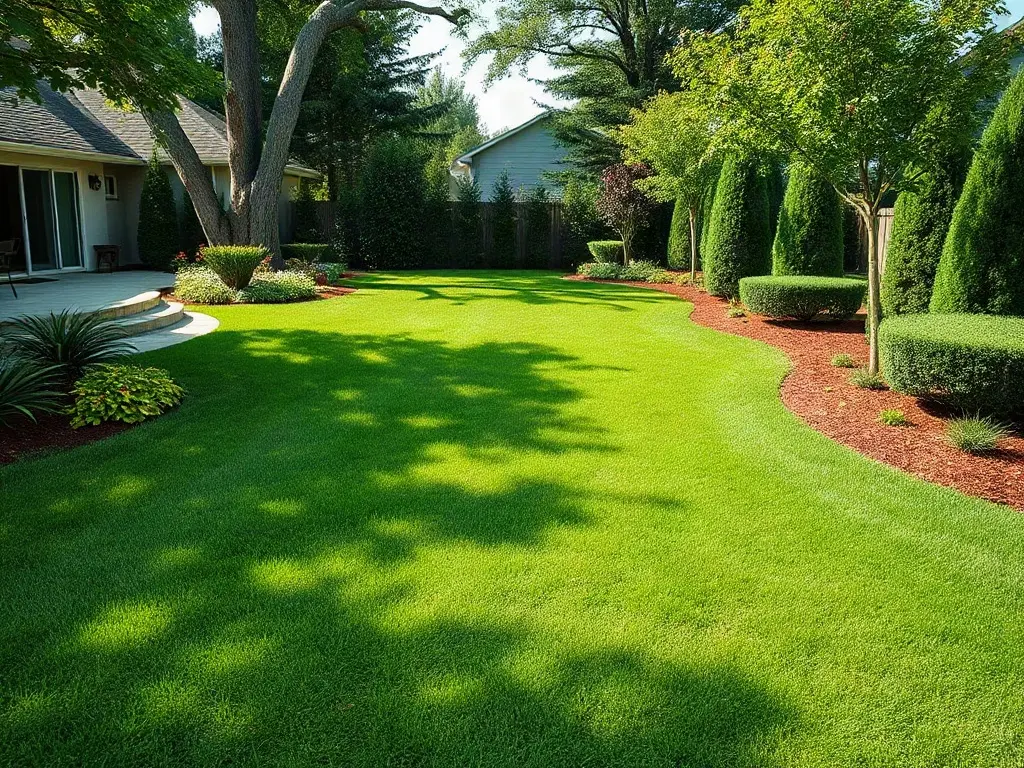
Never price from gross lot size—price from the turf you actually push a mower across. Before you calculate a rate, subtract everything that isn't grass: the house footprint, driveway, patios, pool, decks, wooded areas, planting beds, and fenced-off sections.
A "quarter-acre lot" with a big house, a three-car drive, and a pool might only have 6,000 sq ft of mowable turf. Price the 10,900 and you'll lose the bid; price the real 6,000 and your number holds up. This is the single most common reason per-sq-ft quotes come in wrong.
Measuring from aerial imagery with a tool like Mower Math lets you trace only the mowable turf and get square footage without a tape measure or a site visit—then the formula above does the rest. It's the difference between guessing a lot size off the listing and quoting the actual grass.
Using a lawn mowing quote calculator the right way
A lawn mowing quote calculator is only as good as the costs you feed it, so build your target price per visit from your own numbers before you ever divide by square footage. Your target should cover labor, fuel, equipment wear, overhead, and the profit margin you actually want—not a competitor's price you reverse-engineered.
Build your target price per visit first
Figure your fully loaded cost per hour—wages, truck, trailer, mower, trimmer, fuel, maintenance, insurance—then estimate mow time for the property and add your margin. That dollar figure is what you drop into the formula. A lawn care estimate calculator that starts from your costs beats any generic rate chart because your fuel bill and drive times aren't the national average.
Then sanity-check against the range
Once you have a number, divide by mowable square footage and compare it to the $0.002–$0.009 band for the lawn's size. If a 12,000 sq ft lawn pencils out at $0.015 per sq ft, you're either slow, over-equipped for the job, or about to lose the bid. If it lands at $0.001, you forgot your minimum.
When per-square-foot pricing actually wins the bid
Per-square-foot pricing is most defensible on large estates, HOAs, commercial properties, acreage, and irregular sites—buyers there expect measured bids and compare vendors on a rate. A property manager reviewing five proposals wants to see $/sq ft so they can line them up side by side.
Residential homeowners are the opposite. They almost always accept a clean flat per-visit price—"$55 a cut"—more readily than a rate card full of decimals. So keep per-sq-ft as your internal math and present a flat number on the instant lawn quote you hand the customer. You get pricing discipline; they get a simple answer.
Set a minimum charge so small lawns don't sink you
Always set a minimum service charge, because a 2,000 sq ft lawn still costs you real money to service. Drive time, unloading, trimming, edging, blowing, payment processing, and customer texts all happen whether the lawn is 2,000 feet or 20,000. Per-foot math on a tiny yard returns a number that won't cover any of that.
Most solo operators and small crews set a floor around $40–$50 per visit. If your formula spits out $18 on a postage-stamp lawn, the minimum overrides it—or you decline the stop because it won't fit the route profitably.
What your mowing price should and shouldn't include
A standard mowing price usually covers mowing, string trimming, edging, and blowing off hard surfaces—and nothing beyond that. Spell it out on the estimate so expectations are set before the first mow.
Price these separately, every time:
- Leaf cleanup and bagging
- Severely overgrown or neglected turf (first cut premium)
- Steep slopes and hand-mowing
- Heavy obstacles, tight gates, and fenced mazes
- Clipping haul-away
How often and how high a lawn gets cut also affects your time on site—following sound mowing-height and frequency guidance from Clemson Cooperative Extension keeps turf healthy and keeps overgrown-lawn surprises off your route. Overgrowth is a pricing event, not a freebie.
Tying pricing to route density and getting paid
A great per-sq-ft rate still underperforms if your route is spread across town, because drive time is the fixed cost quietly eating your margin. Clustering stops is how you keep that "show-up cost" low and your effective hourly rate high—our breakdown of how to reduce drive time between mowing jobs covers the route math in detail.
And once the price is set and the lawn is cut, invoicing shouldn't be a notebook-and-shoebox operation. For scheduling, client management, and getting paid, Service Penguin handles jobs and invoicing and is free for solo operators and small crews—so your pricing discipline carries all the way through to the deposit.
Bottom line on charging per square foot
Charge somewhere in the $0.002–$0.009 per sq ft band for recurring residential lawns, let the rate climb only on small or difficult lots, and always divide a real target price by real mowable square footage. Measure the grass, not the lot. Set a minimum. Present a flat price to homeowners and a per-foot rate to commercial buyers. Do that and your quotes stop being guesses and start being a system.
What is a good minimum charge for small lawns?
Most operators set a minimum between $40 and $50 per visit regardless of size. A 2,000 sq ft lawn still costs you drive time, unloading, trimming, edging, blowing, and payment processing. If your per-sq-ft math returns $22 on a tiny yard, the number is wrong—your minimum protects the stop from losing money.
Should I quote per square foot or a flat per-visit price?
Quote a flat per-visit price to residential customers and keep per-sq-ft as your internal math. Homeowners accept 'a $55 visit' far more readily than a rate card. Per-sq-ft pricing is most defensible on estates, HOAs, commercial sites, and acreage, where buyers expect measured bids and compare apples to apples.
Why does price per square foot drop on bigger lawns?
Fixed costs—drive time, unloading, setup, and cleanup—happen once per stop no matter the lawn size. At $60 a visit, 5,000 sq ft works out to $0.012 per sq ft, 10,000 sq ft to $0.006, and a full acre to $0.0014. The more turf you cover per stop, the cheaper each foot becomes.
What's included in a standard mowing price?
A standard mowing ticket typically covers mowing, string trimming, edging, and blowing off hard surfaces. Leaf cleanup, bagging, severely overgrown turf, steep slopes, heavy obstacles, and haul-away are extras you price separately. Spell out what's included on the estimate so the first add-on request doesn't turn into an argument.
How do I convert a target price into a per-sq-ft rate?
Divide your target price per visit by the measured mowable square footage: price per sq ft = target price ÷ mowable sq ft. If you want $65 on a 9,000 sq ft lawn, that's about $0.0072 per sq ft. Run it in reverse to sanity-check a bid against your local rate range.
References
- University turf guidance on mowing frequency and cut height that drives how long a lawn takes to mow — Clemson Cooperative Extension (Home & Garden Information Center)