How Accurate Is Satellite Lawn Measurement?
Satellite lawn measurement is usually within a few percent on clean residential lots — accurate enough to quote and buy materials. Here's when it drifts, and how to check.
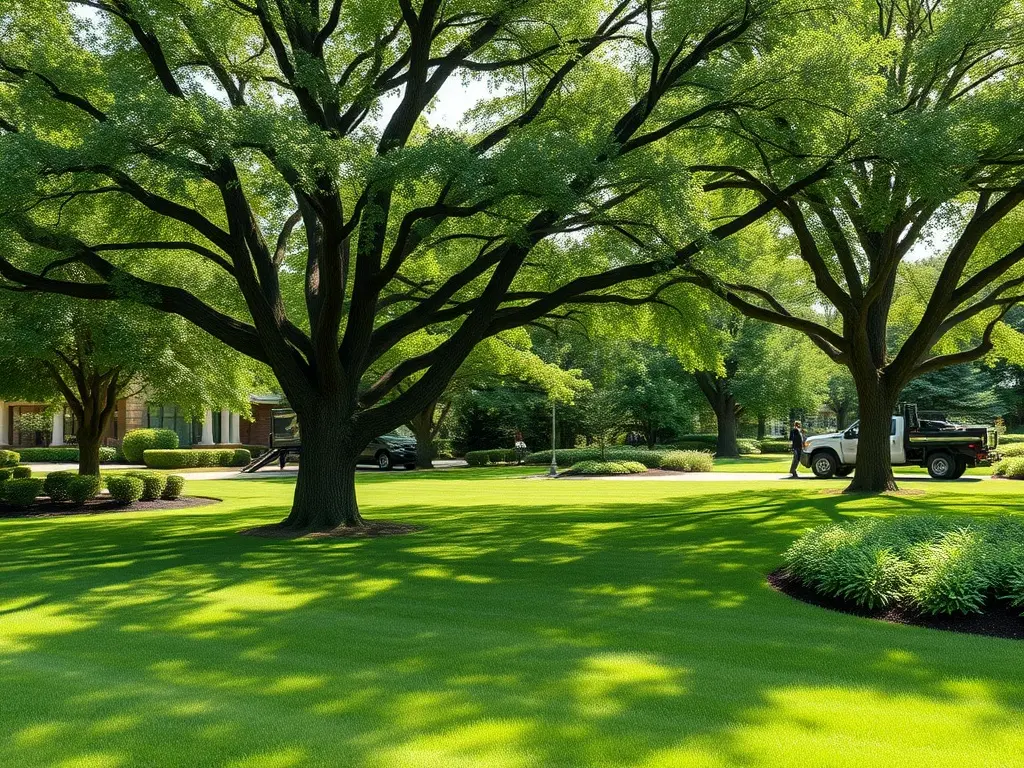
Short answer: satellite lawn measurement is accurate enough to quote jobs and calculate materials — typically within a few percent of a tape measure on a clean, open residential lot. On simple properties where you can clearly see turf against beds and pavement, expect roughly 1–3% error. Where tree canopy, narrow strips, or very small lawns get involved, it can drift to 5–10% or worse. It is not the same as a physical survey, but for pricing work it usually doesn't need to be.
That's the whole thing in a paragraph. If you quote lawns for a living, though, the interesting part is when it's tight, when it's loose, and how to tell the difference before you send a number.
How accurate is satellite lawn measurement in real numbers?
Accuracy depends on three things: image quality, how complicated the property edge is, and how carefully whoever's tracing follows the actual turf line. Get those right and you land close.
The range you'll see quoted breaks down like this:
- 1–3% on many residential and commercial lots under good conditions — one source pins it at within ±3% of a tape-measured value.
- 2–5% in more cautious descriptions.
- 5–10% on typical suburban lots in real-world practice, which is more honest than the tightest marketing-style claims.
- Vendor claims of 95%+ accuracy in 10–15 minutes with no site visit exist too — but treat those as vendor claims, not independent benchmarks.
For most mowing and treatment work, even the loose end of that range is fine. If a 6,000 sq ft lawn is actually 6,300, you're 5% off — that's a few dollars on a mow and a rounding error on a bag of fertilizer. You round up on materials anyway.
Where a lawn measurement tool nails it
Satellite is most reliable on larger, simple lots: a big open backyard, a clean commercial turf panel, a subdivision lot with obvious property lines. The bigger and simpler the shape, the smaller any tracing error becomes as a percentage. On those, a good lawn measurement tool gets you to a defensible number faster than you could walk it with a wheel.
Where it gets loose
Three things cause most of the error:
- Tree canopy hiding the turf edge. If a maple is covering the fence line, you're guessing where grass ends. This is the single biggest accuracy problem on wooded residential lots.
- Narrow strips and mixed-use edges. Hell strips, side yards, the ribbon of grass between a driveway and a bed — small absolute errors here pile up.
- Very small lawns under 500 sq ft. On a tiny urban lot, a single pixel or a sloppy trace is a much bigger percentage of the total. The same 30 sq ft mistake that's noise on a half-acre is a 6% miss on a 500 sq ft lawn.
There's a reason to stay humble here. A research paper on satellite-based area estimation in a more complex classification setting found only poor to moderate agreement and real overestimation in places — a reminder that satellite-derived area gets unreliable when the problem is harder than tracing an obvious turf edge. Tracing a clean lawn is easy. Sorting turf from weeds from shaded brush from a gravel path is not.
A worked example: what a few percent actually costs you
Say you measure a suburban lot online and get 8,000 sq ft of turf. Your price is based on your own costs — let's say your model works out to $0.009 per sq ft for a mow, so the quote lands at $72.
Now assume the measurement is off by the honest suburban figure of 8%. Real turf is 8,640 sq ft. The "correct" price would've been about $78 — a $6 gap on a weekly account. Over a season of 30 cuts, that's $180 you left on the table on one property, because you trusted a canopy-obscured trace without checking it.
Flip it the other way and an 8% overestimate means you quoted $78 for a $72 job — you're a hair high, maybe you lose the bid to someone who measured tighter. Either way, the lesson isn't "don't use satellite." It's verify the edges that matter. On that same lot, re-checking the tree-covered back corner might move your number by 3–4%, and that's the difference between a good quote and a sloppy one.
How to measure my lawn online without getting burned
The workflow that keeps you accurate is the same whether you're using a full lawn measurement app or a basic lawn size calculator:
- Trace turf, not the whole parcel. Subtract the house, driveway, patio, pool, and beds. The number you charge for is grass, not lot size.
- Zoom in on complicated edges. Narrow strips and curved bed lines are where careful tracing pays off.
- Flag anything under canopy. If you can't see the ground, you're estimating — note it and pad your uncertainty.
- Re-check properties that changed. New patio, ripped-out bed, added fence? Old imagery lies. Confirm before you commit to a season price.
- Sanity-check the total. If a lawn you've mowed "feels" like a quarter acre and the tool says 4,000 sq ft, one of you is wrong.
For the standards side of this — knowing how much detail aerial imagery can actually resolve — the USGS explains how remotely sensed imagery resolution works, which is worth a skim if you want to understand why some images trace cleanly and others go fuzzy at the edges.
Is a lawn measurement app accurate enough to quote from?
For quoting, buying product, and estimating turf area — yes, on the vast majority of properties. The measurement's job isn't to match a surveyor's plat to the inch. It's to get you a defensible number without a site visit, then let you adjust for the tricky cases. Absolute map positioning matters far less than relative boundary tracing on a single property; one source calls typical results "close enough" at around ±10 sq ft for many uses.
This is exactly where a tool like Mower Math earns its keep for a route-based operator: measure any lawn from aerial imagery, price it from your own costs, and send a branded estimate without burning a half-hour of drive time on a site visit. If you want the deeper version of that workflow, we broke it down in how to quote lawn mowing jobs without a site visit.
Bottom line: satellite lawn measurement is typically within a few percent on clean residential lots and accurate enough to run a real quoting workflow. Respect the two failure modes — obscured edges and tiny lots — verify those by eye, and you'll price faster and more consistently than any wheel-and-clipboard routine.