How to Quote Lawn Mowing Jobs (Without a Site Visit)
A step-by-step guide to quoting lawn mowing jobs profitably — measure the lawn, price from your real costs, add overhead and markup, and get the quote out fast.
Quoting lawn mowing jobs comes down to three things: knowing the lawn size, knowing your own costs per hour, and getting the number in front of the customer before your competitor does. Get those right and you stop leaving money on the table on every route. Get them wrong and you either lose the bid or win a job that pays you $22 an hour to bleed gas money.
This is the practical, been-there guide on how to quote lawn mowing jobs — the workflow, the math, the numbers most operators actually charge in 2026, and the mistakes that quietly wreck your margin.
The 6-step workflow for quoting lawn mowing jobs
Nearly every solid quoting guide follows the same order, and there's a reason for it. Do these in sequence:
- Measure the lawn. Turf area, not lot size.
- Assess conditions. Grass height, density, slope, obstacles.
- Add extra services and materials. Edging, blowing, debris, trimming.
- Calculate labor. Time on site × your crew's real hourly cost.
- Add overhead. Trucks, insurance, fuel, admin — the stuff you pay whether you mow or not.
- Add profit. Markup on top, not baked into your labor rate.
The key detail most people miss: overhead and markup come after your base labor and materials estimate — not mixed into it. Estimate the raw cost of doing the work first, then layer profit on top before it becomes a customer-facing number.
Step 1: Measure the lawn (this is where most quotes go wrong)
You can't price what you haven't measured. Guessing "looks like a quarter acre" is how you end up 40% under on a corner lot with a big side yard.
For most residential mowing jobs, you don't need to drive out and roll a measuring wheel. Aerial measurement is accepted practice — you can pull up the property and measure the turf from overhead imagery. For bigger or more complex properties — steep grades, heavy tree cover, drainage, tight access — an in-person walkthrough is still the smart call before you commit to a number.
This is exactly the gap Mower Math fills: drop in any address, measure the actual turf from aerial imagery, and price it from your own costs without leaving the driveway. It's a genuine time saver when you're quoting a stack of leads in an evening instead of burning a Saturday driving to each one.
Turf area, not lot size
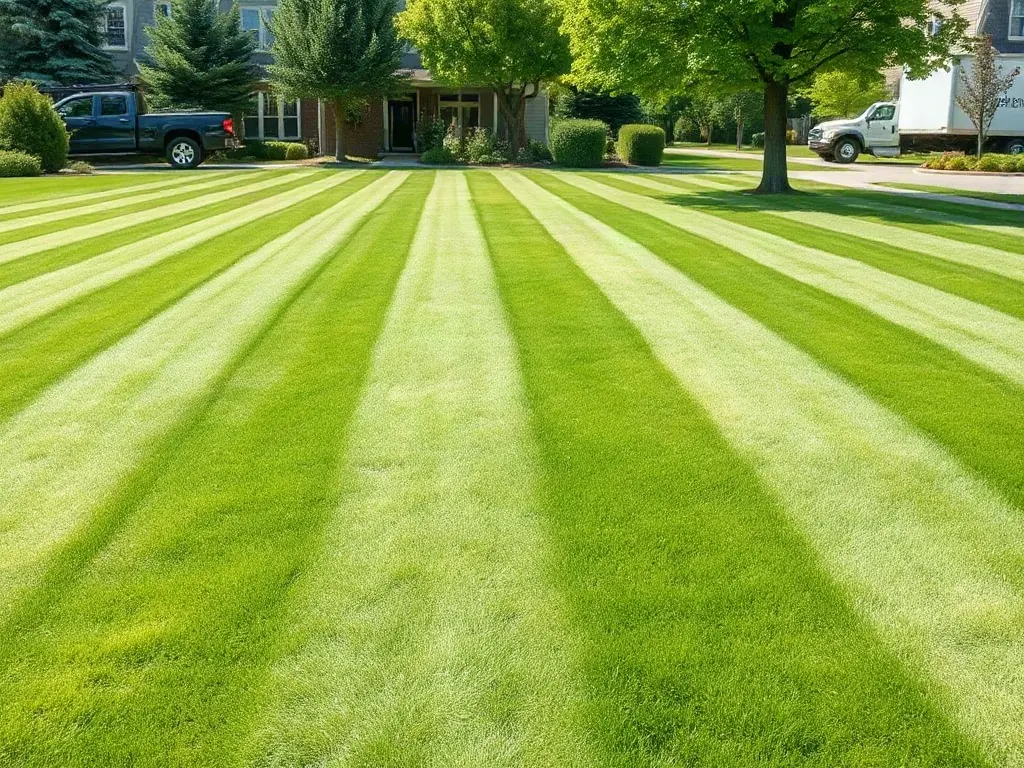
A 0.3-acre lot might have 6,000 sq. ft. of mowable grass after you subtract the house, driveway, beds, and pool deck. Measure the green, not the parcel.
How to price it: the numbers pros actually charge in 2026
Here's the range to anchor against. A typical U.S. lawn mowing quote in 2026 runs about $50–$250 per visit, and larger or more complex jobs with added maintenance tasks push into the $125–$450 range. Beneath those totals, operators use a few different pricing methods:
- Hourly: roughly $30–$65 per hour for lawn care work.
- Per acre: commonly $150–$200 per acre on larger lawns.
- Per square foot: about $0.01–$0.06 per sq. ft.
- Simple acreage formula: Echo's business guidance uses price = 100 × total acreage, with a $35 minimum.
Those methods are useful gut-checks, but the pro move is to estimate the time first, then multiply by your target hourly earnings — not to guess from property size alone. Two lawns the same size can take wildly different amounts of time depending on obstacles and terrain.
The labor math, worked out with real numbers
Labor is the core of your quote. The formula the industry uses:
Labor cost = (job hours × number of workers) × (hourly wage × overhead multiplier)
Let's run it. Say a job takes 3 hours with a 2-person crew — that's 6 labor hours. You pay $18/hour, and you carry a 20% overhead multiplier on wages (payroll taxes, workers' comp, the stuff on top of the paycheck). Your loaded labor rate becomes $21.60 per worker-hour.
6 labor hours × $21.60 = $129.60 in labor cost.
That $129.60 is your cost, not your price. Now you add business overhead (trucks, insurance, fuel, admin) and then your profit markup. If you want a 30% margin on top, you're quoting somewhere north of $185 for that visit — and that's before any add-ons.
Don't forget the extras
Trimming, edging, blowing off hardscape, debris removal, and tall or dense grass all add time and therefore cost. Grass height, density, slope, and obstacles are the non-price factors that legitimately move a quote up. If a lawn hasn't been cut in a month, that's not a standard mow — price it like the double-cut it actually is.
Using a lawn mowing quote calculator vs. eyeballing it
A lawn mowing quote calculator (or a lawn care estimate calculator) is just the workflow above turned into repeatable math so you're not reinventing the number on every driveway. The value isn't magic — it's consistency. When you price the same way every time, you can look back at completed jobs and see where your estimates were off, then tighten them.
A good lawn quoting tool ties three inputs together: measured turf area, your real per-hour cost, and your target margin. That's the whole engine. Mower Math works as a lawn mowing estimate app in exactly this way — it measures from aerial imagery and prices the job from your costs, so the estimate reflects your business, not some national average. And because it can pull neighboring lots, you can quote for route density instead of one lawn in isolation.
Route density: the hidden profit lever in every quote
Two $60 lawns on the same street are worth far more than two $60 lawns 20 minutes apart, because drive time is dead time you're paying for. Quoting tools increasingly push route clustering for exactly this reason — reduced windshield time is straight profit.
When you're quoting a new lead, check whether you already service the street or the subdivision. If you do, you can afford to be a little sharper on price and still make more per hour than a scattered job across town. Mower Math's Find Neighbors feature is built around this — it helps you quote the block, not just the house.
One-time vs. recurring: price them differently
A one-time mow should always be priced higher than your recurring rate. Recurring customers give you predictable route revenue and a lawn that stays manageable; a one-off is a scheduling interruption on an overgrown lawn you may never see again. Charge accordingly — a 25–50% premium on one-time cuts is normal and defensible.
Check your local market — then set your own number
It's smart to know what nearby operators charge before you lock in your pricing. Compare local rates, then adjust for property size, condition, and scope. But comparing is a sanity check, not a strategy — if your costs say $185 and the market says $150, the answer isn't to lose $35, it's to be faster or leaner or to walk. For broader industry benchmarks and business resources, the National Association of Landscape Professionals is a solid reference point.
How fast should you respond to a lawn care lead?
Fast. Faster than that. The operator who sends an instant lawn quote — or at least a same-hour response — wins a wildly disproportionate share of jobs, because most homeowners hire the first pro who gives them a real number. If you're waiting until the weekend to drive out and measure, you've already lost leads to whoever quoted from their phone that afternoon.
This is the single biggest reason aerial measurement matters for small operators. Being able to measure and quote a lawn in minutes, from a text message, turns speed-to-lead into your competitive edge instead of your weak spot.
Always send a written quote
Verbal numbers cause disputes. Give every client a written estimate that clearly lists the services included and the total price. It sets expectations, it looks professional, and it protects you when someone "remembers" the price being lower. A clean, branded PDF estimate closes better than a scribbled number on a business card — and it makes the small operator look like the established company.
Quick recap: the quoting checklist
- Measure the actual turf — aerially for standard residential, in person for complex.
- Estimate time on site, including trimming, edging, and blowing.
- Multiply loaded labor hours by your real hourly cost.
- Add business overhead, then add profit markup on top.
- Price one-time jobs higher than recurring.
- Check route density before you commit to a rate.
- Sanity-check against local rates.
- Send a written quote — fast.
Nail this workflow and quoting stops being a guessing game. You'll price consistently, protect your margin on every visit, and win more of the leads you actually want.