How to Give a Lawn Estimate Over the Phone
A step-by-step phone-quote workflow for lawn pros: what to ask, how to price from your own costs, and how to give a fast, accurate estimate without a site visit.
Yes — you can learn how to give a lawn estimate over the phone that's accurate enough to win the job, and you can do it in under five minutes. The trick is that a good phone quote isn't a guess. It's a measured number backed by your own costs, framed as a range so unknowns like overgrowth and slope don't burn you. Do it right and you close leads while your competitor is still "trying to swing by Thursday."
This is the full playbook: the questions to ask, the math to run, the script that protects your margin, and the mistakes that turn a phone quote into a money-loser.
Can you actually give a lawn estimate over the phone?
You can — and for standard residential mowing, you usually should. The best practice is to treat the phone number as an initial quote or range unless you've already measured the property. Most lawn-care pricing guides agree: you can complete an estimate over the phone and only book a final in-person quote if the lead is still on the fence.
The reason phone quotes work is that the biggest variable in a mowing price — how much grass you're cutting — no longer requires you to physically drive out. You can measure the lawn from aerial imagery before you even pick up the phone, then use the call to tighten the number with conditions the satellite can't see: gates, dog waste, steep banks, how long since the last cut.
Where phone quotes go wrong is when operators skip the measurement and just blurt a neighborhood average. That's not a quote, that's a coin flip. The most reliable way to price over the phone is to base the number on your loaded hourly cost plus overhead and profit — not on a flat guess.
The phone-quote workflow, start to finish
Here's the sequence that keeps calls fast and consistent. It's the same flow whether the lead comes in by phone, text, or web form:
- Capture the address. Everything starts here. The address unlocks the measurement.
- Measure the lawn from aerial imagery while you're talking — or before you call back.
- Ask five condition questions (below) to catch what imagery misses.
- Give a range on the call, framed with what's included.
- Send the written quote by text or email immediately.
- Follow up within 48 hours if you haven't heard back.
Notice the order. You measure first, then talk, then send. The call isn't where you calculate the price from scratch — it's where you confirm the conditions and deliver a number you already trust.
The five things every phone quote needs
A strong phone quote covers, at minimum:
- Property size — the mowable square footage, measured, not eyeballed.
- Service frequency — weekly, biweekly, one-time. Frequency changes your per-visit price.
- What's included — mowing, edging, trimming, blowing. Spell it out.
- Access issues — gate width, locked fences, parking, dogs.
- Special conditions — overgrowth, steep slopes, heavy trimming, obstacles.
Those last two are exactly why you give a range instead of one flat number. Overgrowth, hills, and access problems are the unknowns that eat your time, and mowing tall or infrequently cut grass takes longer and stresses the turf — most university turf programs, like Colorado State University Extension's lawn care guide, recommend never removing more than a third of the blade at once, which means an overgrown first cut often needs a slower pass or a double-cut. That's billable time you have to build in.
Pricing from your own costs, not a neighborhood average
This is the part most operators skip, and it's the whole game. A phone quote is only as good as the math behind it. Price from your machine's production rate, add penalties for obstacles, edging, slope, and gate limitations, then convert time to money using your loaded hourly cost.
Your loaded hourly cost is what an hour of your business actually costs to run — labor, fuel, equipment wear, insurance, maintenance, and the drive time between stops — before a dime of profit. If you don't know that number, quoting is guessing.
A worked example
Say a lead calls about weekly mowing. You pull the address, measure it from aerial imagery, and it comes back at 8,000 sq ft of mowable turf on a standard lot.
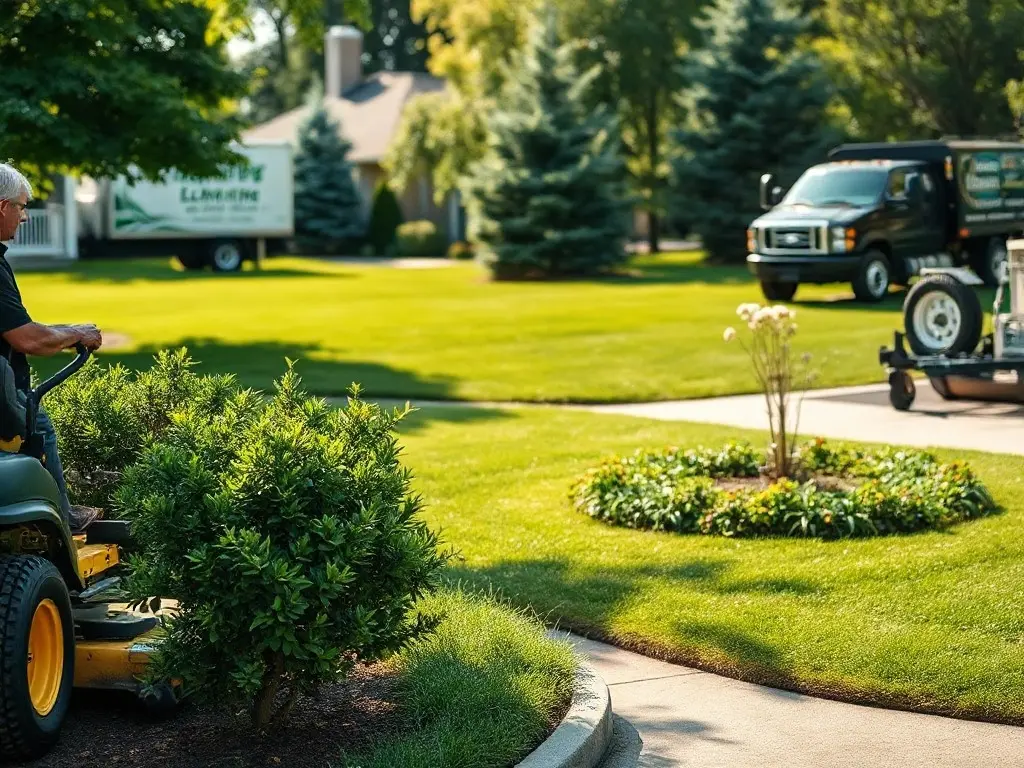
- Your 36" walk-behind cuts open turf at roughly 20,000 sq ft/hour, but this lot has a fenced backyard and several beds to trim around, so realistic production drops to about 12,000 sq ft/hour.
- 8,000 sq ft ÷ 12,000 = 0.67 hours of mowing.
- Add edging, trimming, and blowing: ~15 minutes, call it 0.25 hours.
- Total on-site time: ~0.92 hours, round to 1 hour with cleanup.
- Your loaded hourly cost is $65/hour, and you want a 30% margin, so you target ~$85/hour billed.
- 1 hour × $85 = $85, but for a tight standard lot you'd more likely land around $45–$55 per visit once you factor competitive market rates.
That lines up with real-world numbers — one reported market puts weekly maintenance at $40–$65 per visit for a standard lot, though that's local and not a national figure. You'll also see broad national ranges thrown around, like a $214–$322 average per service, but those are so wide they're useless for a specific driveway. Your measured square footage and your own costs are what make a phone quote defensible.
On the call, you don't recite this math. You say: "For weekly mowing, edging, trimming, and blowing on your property, you're looking at $45 to $55 a visit. If the grass is over about six inches on the first cut, there's a one-time overgrowth charge — I'll confirm the exact number when I see it." That's a range, framed with what's included and what could move it. Never just say one number with no context.
A lawn mowing quote calculator beats mental math
You can run the numbers above in your head once. Doing it forty times a week, on the phone, without errors? That's where a lawn mowing quote calculator earns its keep. A good lawn care estimate calculator does three things a legal pad can't: it measures the lawn, applies your cost inputs the same way every time, and produces a written quote you can send before the lead hangs up.
This is exactly the use case Mower Math was built for — it measures any lawn from aerial imagery and prices the job from your own loaded costs, so a phone quote takes seconds instead of a drive-by. If you want the deeper mechanics of pricing without leaving the truck, our guide on how to quote lawns without a site visit walks through it.
The point isn't the tool for its own sake. It's that a lawn quoting tool or lawn mowing estimate app removes the two things that make phone quotes scary: slow math and inconsistent pricing. When every quote comes off the same system, your $45 lot and your neighbor's $45 lot are actually priced the same way.
How fast should you respond to a lawn care lead?
Fast. Faster than you think. One lawn-business estimate guide recommends responding within 5 minutes, because speed-to-lead is directly tied to winning more jobs. When someone calls three companies, the first one to hand them a real number usually gets the work — the other two are still "getting back to you."
This is the hidden advantage of phone quoting done right. If you can measure the lawn and give an instant lawn quote on the first call, you're not competing on price — you're competing on being the pro who actually showed up (by phone) and made it easy. We broke this down further in the speed-to-lead guide, but the short version: measured number + five-minute response = booked job.
What to do after the quote lands
Say yes comes back. Now the phone estimate turns into real work: putting the job on the calendar, tracking the client, and getting paid. That's where the estimate hands off to your field-service system. For scheduling, client management, jobs, and invoicing, Service Penguin covers that workflow and is free for solo operators and small crews, so the win on the phone doesn't get lost in a notebook.
Keep a light paper trail even on phone quotes: date, address, measured size, the range you gave, what's included, and any condition flags. When the customer says "you told me $45" three weeks later, your note settles it in five seconds.
Phone-quote mistakes that cost you money
- Quoting without measuring. A drive-by guess or a flat neighborhood rate ignores the one number that drives the price.
- Giving a single flat number. No range means no room for overgrowth, slope, or access surprises. You eat the difference.
- Forgetting to name what's included. "$45" and "$45 for mow, edge, trim, blow" are different promises. Say the second one.
- Slow follow-up. If you don't send the written quote fast and follow up within 48 hours, a five-minute competitor takes the job.
- Not knowing your loaded hourly cost. Every quote you give is a bet. Know your number so the bet is in your favor.
Give a phone estimate the way you'd want to receive one: fast, specific, and honest about what could change it. Measure first, price from your own costs, quote a range, send it in writing, and follow up. Do that on every call and "how to give a lawn estimate over the phone" stops being a question — it becomes your fastest way to fill the route.