Why Mowing Is the Most Profitable Lawn Service
Mowing isn't the highest-margin service on paper, but for solo operators and small crews it's the best profit engine you can build. Here's the crew math on why.

Here's the short answer to why mowing is the most profitable lawn service for most solo operators and small crews: it's not because mowing has the fattest margin per job — it doesn't. Treatments, irrigation, and installs usually beat it there. Mowing wins because it's the easiest service to systemize into recurring, high-frequency, low-drive-time revenue. Tighten your route, quote from real costs, and stack stops, and mowing becomes the most reliable dollar you'll earn all season.
Let me back that up with the numbers, because "most profitable" gets thrown around loosely.
Why mowing is the most profitable lawn service for small operators
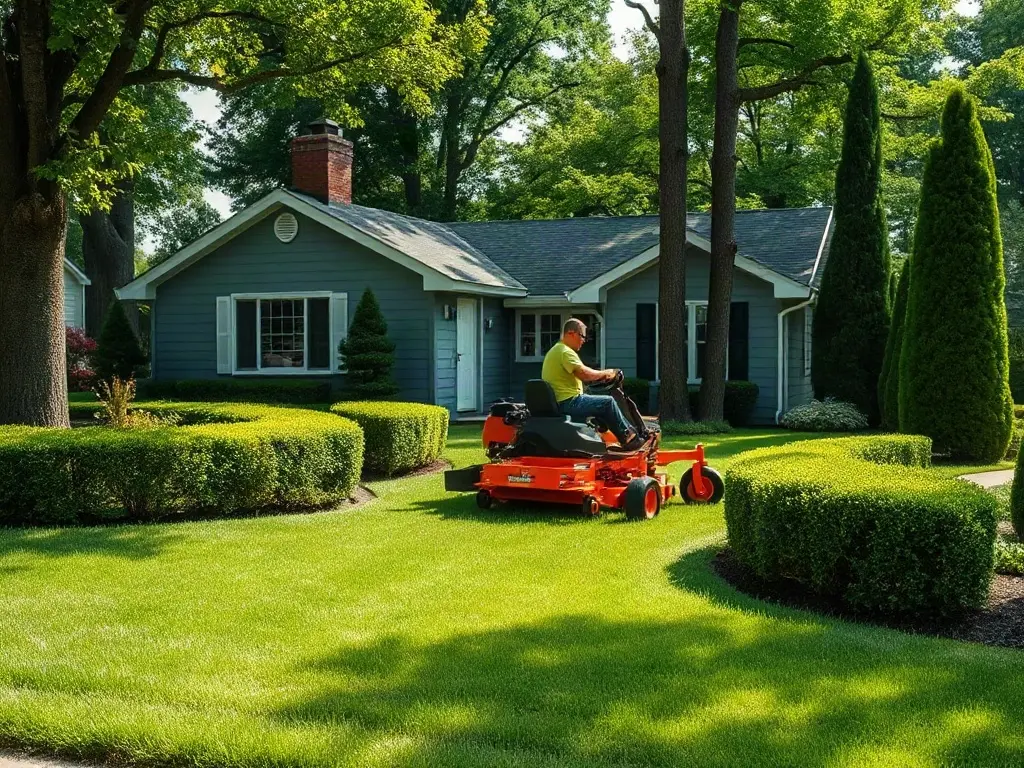
Mowing has the lowest barrier to start, the fastest cash cycle, and the most repeat frequency of any lawn service. You cut a lawn, you get paid, and you're back in 7 to 14 days to do it again. That recurring contact is the whole game.
Compare that to the higher-margin stuff. Fertilizer, weed control, aeration, hardscaping, and irrigation installs typically post better margins per job than mowing does. But they're one-off or seasonal, they need more setup, and many require licensing you may not have yet. Mowing is the service that pays the bills every single week while those other jobs come and go.
The catch: mowing is only the most profitable service when it's run well. Published industry guidance commonly puts residential mowing profit around 10%–20% per job. Anything under 10% is a warning sign, and a lot of operators treat 15% as their floor. The difference between a 10% job and a 20% job usually isn't price — it's routing and cost discipline.
Lawn mowing business profit margins, in plain numbers
A realistic 2026 benchmark for a well-run lawn-care business is about 15%–30% net margin. Solo operators often land higher — around 25%–40% — because their overhead is low and they can quote directly from their own cost structure. Once you add employees, margins typically compress to 12%–25% as payroll, coordination, and insurance climb. You make more total dollars with a crew, but you keep less of each one.
That's the tradeoff nobody tells you when you're starting out. Bigger isn't automatically more profitable. A tight solo route can out-earn a sloppy three-truck operation on a percentage basis.
A worked example
Say a residential mow runs $50 a visit — right in the middle of the roughly $30–$85 range industry sources cite for 2026. Actual price depends on lot size, complexity, access, and frequency, but $50 is a fair mid-market number.
Now picture two operators, both charging $50:
- Operator A drives 15 minutes between stops. On a 20-lawn day, that's 5 hours of windshield time — unpaid, burning fuel, wearing the truck.
- Operator B has a dense route with 5-minute hops. Same 20 lawns, but only about 100 minutes of drive time. That's nearly 3.5 hours freed up — enough to fit 4 more mows at $50 each.
Same price, same equipment, same skill. Operator B pockets an extra $200 a day just from route density. Do that five days a week and you're talking real money by season's end. Mowing pays the operator; windshield time doesn't.
Route density is the biggest profit lever in mowing
This is why tight routing gets cited over and over as the core profitability driver in lawn care. Every nearby account you add brings in revenue with almost no extra drive time. Your fixed costs — insurance, equipment depreciation, the truck payment — get spread across more stops. Each new neighbor essentially subsidizes the whole route.

Pricing from true cost matters just as much. Mowing margins get squeezed by labor, fuel, equipment depreciation, insurance, and drive time. When you don't build those into the quote, mowing turns low-profit fast. Trying to "be the cheapest" is how operators end up working 60-hour weeks for 8% margins. The University of Maryland Extension's guidance on mowing practices for healthy lawns is a good reminder that doing the job right — proper cut height, sharp blades — protects both the turf and your reputation, which is what keeps recurring accounts recurring.
How to get lawn mowing customers fast — and how many you need
The most common question new operators ask: how many customers does a lawn business need? There's no universal number, but the useful way to think about it is by density, not headcount. Forty accounts spread across a county can be less profitable than 25 clustered in three neighborhoods.
To get lawn mowing customers fast, the fastest lever is the one right in front of you: the neighbors of the customers you already have. Instead of chasing leads 20 minutes away, go door-to-door around an existing stop. You already know the lot type, the drive is already covered, and you can quote on the spot.
This is exactly where Mower Math earns its keep. It measures any lawn from aerial imagery so you can quote from the truck using your own costs — no site visit — and its Find Neighbors feature surfaces the nearby homes that would tighten your route. It's not a CRM and doesn't try to be; use whatever CRM you like for scheduling and invoicing. Mower Math is the measuring-and-quoting layer that keeps site visits off your calendar and revenue on your route.
How to grow a mowing route from 20 to 100 customers
Growing from 20 to 100 customers isn't about advertising harder. It's about layering:
- Get the first 20 clustered. Pick two or three target neighborhoods and go deep, not wide.
- Farm the neighbors. Every time you land a job, quote the three closest houses. Density compounds.
- Quote fast and consistently. The operator who sends a clean estimate the same day usually wins. Speed-to-quote is a real advantage.
- Hold your pricing. As volume grows, resist the urge to discount. Consistent pricing plus tight routes beats cutting more lawns cheaper.
- Feed the add-ons. Weekly mowing creates recurring contact, which is the natural on-ramp to higher-margin services.
The most profitable services for a lawn care business build on mowing
Here's the strategic point. Mowing may not be the highest-margin service, but it's the one that opens the door to the ones that are. Every week you're on a property, you're building trust and spotting work: a lawn that needs fertilizer, beds that need weed control, compacted soil that needs aeration, a fall cleanup. Those add-ons carry better margins, and you're not paying to acquire the customer twice.
That's why the businesses making the most money aren't just cutting more grass. They combine tight routes, fast production, consistent pricing, and recurring volume — then stack profitable extras on top of a mowing base they already own.
If you're starting a lawn mowing business in 2026
Start with mowing. It's the fastest path to cash flow and the cheapest to launch. Price every job from your real costs — not the guy down the street's flyer. Build density before you build headcount. And treat mowing as the engine that pulls the profitable add-ons behind it, not the whole train.
Do that, and the question stops being whether mowing is profitable. It becomes how many neighbors you can add before the season's out.