Should I take a lawn care customer outside my route?
Only take an out-of-route lawn care customer if the price premium covers the extra miles, the dead drive time, and the density you lose on the rest of the day. Use the IRS mileage rate as your travel-cost floor. If a distant lawn pays enough to beat your revenue-per-hour on a tight route, take it. If it just fills a gap at normal price, pass.
- Route density, not ticket size, is one of the biggest profit levers in lawn care.
- Use the IRS mileage rate (72.5¢/mile early 2026, 76¢/mile later) as the floor cost of every out-of-route mile.
- A strong day route runs about 8–12 stops within a 3-mile radius, at 2.0–3.0 stops per hour.
- An out-of-route account is worth it only when the premium beats your revenue-per-labor-hour target of $100–$150.
- Measure a distant lawn from aerial imagery before you drive out to quote it.
Should you take a lawn care customer outside your route? Only if the price premium covers the extra miles, the dead drive time, and the density you give up on the rest of the day. Use the IRS mileage rate as your floor for travel cost. If the distant lawn pays enough to beat what an hour earns on a tight route, take it. If it's a normal-priced mow that just happens to be far away, pass—it quietly drags down your whole day.
The instinct is to say yes to every paying customer. But lawn care profit lives in route density, not in the number of names on your list. One out-of-route account can cost you more than it brings in.
Why route density beats ticket size in lawn care
Route density is the single biggest profit lever most solo mowers and small crews ignore. A strong day route runs about 8–12 properties within roughly a 3-mile radius, so you spend your day cutting grass instead of driving between jobs.
The math is brutal when density drops. A low-density route can waste about 2 hours a day just driving, while a tight route cuts that to about half an hour. That's the same equipment, the same labor, and nearly double the daily profit on the dense route—purely because you're not burning the clock on the road.
Fuel follows the same curve. A spread-out route can run $40–$60/day in fuel versus $15–$25/day on a dense one. The EPA's guidance on how driving habits and distance drive up operating cost makes the point plainly: miles cost money whether or not the truck is billing.
How to price an out-of-route lawn using the IRS mileage rate
Price an out-of-route lawn by adding up three costs the extra distance creates, then charging a premium that clears all three. Miss any one and the account loses money without you noticing.
The three costs a distant customer adds
- Miles. The 2026 IRS standard mileage rate is 72.5¢/mile for January–June and 76¢/mile for July–December. A 30-mile round trip is roughly $22 in true vehicle cost—not just gas, but wear, tires, and depreciation.
- Dead drive time. Forty minutes of driving is 40 minutes not mowing. On a route earning $100–$150 in revenue per labor-hour, that lost time is worth $65–$100.
- Lost density. If the trip forces you to drop a nearby stop, subtract that stop's revenue too—residential mowing stops typically run $45–$75 each.
A worked example
Say a customer 15 miles off your route wants weekly mowing and you'd normally charge $50. Round trip is 30 miles—about $22 at the mid-2026 rate—plus roughly 45 minutes of driving, worth about $75 at your target hourly. That's nearly $100 in real cost against a $50 mow. To break even against a tight route, that lawn needs to bill closer to $110–$130, or sit next to two or three others you can pick up on the same trip.
That's why the honest answer is usually "not at your normal price." The exception is when the distant lawn is big enough, or clustered enough, to beat your revenue-per-hour anyway.
Who is the ideal customer for a lawn care business?
The ideal lawn care customer is a recurring account inside your existing route that pays on time and doesn't need hand-holding. Density and reliability matter more than a fat one-time ticket. A $45 weekly mow two doors from another customer outperforms a $120 mow 20 minutes away almost every time.
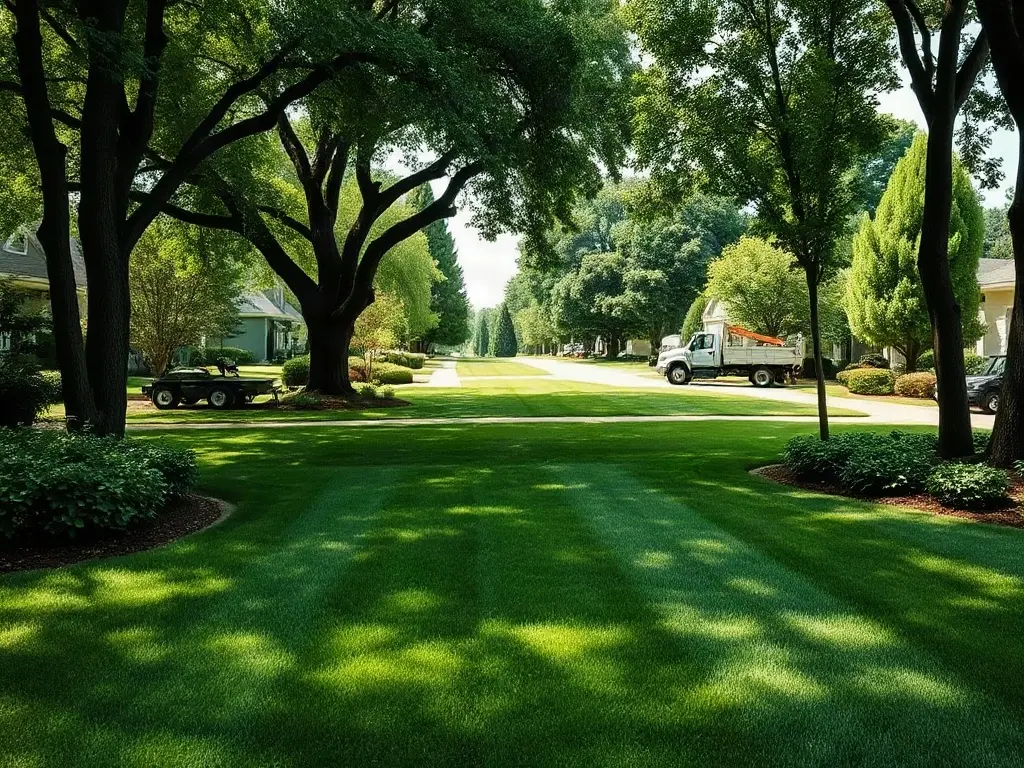
Healthy suburban routes keep stops under about 1.5 miles apart; dense neighborhoods under 0.7 miles. Before you quote a lawn you've never seen, you can measure it from aerial imagery in Mower Math instead of burning a half-day on an unpaid site visit—useful when the address is far enough out that the drive itself is a cost you want to avoid twice.
Are big properties more profitable than small ones?
Big properties are more profitable per stop, but not always per day. A large lawn spreads your fixed setup and drive cost across more billable minutes, which helps margin. The catch is location: a big property far from everything else can earn less in a day than a cluster of small lawns on one street, because the miles and dead time cancel the size advantage.
Run the revenue-per-labor-hour number, not the ticket. If a big out-of-route lawn still clears $100–$150/hour after you fold in the drive, it's a keeper. If it drops you to $60/hour, a tighter route of small lawns wins.
Which lawn care customers should I fire?
Fire the customers who wreck your density or your day: the lone account 20 miles from everyone else, the chronic slow-payer, and the one who wants premium service at a rock-bottom price. Cutting them frees hours you can resell on a tight route. If you're carrying a few of these, our breakdown of which lawn care customers should i fire walks through how to decide.
What lawn care customers actually want is simple and consistent service, clear pricing, and easy payment—not a mower who's always late because he's stuck driving across town. Putting recurring accounts on autopay handles the payment side and cuts the unpaid admin time you spend chasing invoices.
Managing routes, autopay, and scheduling
Once you're deciding what to keep and what to drop, you need one place to see your stops, schedule the day, and bill it. Service Penguin handles scheduling, jobs, invoicing, and autopay for lawn and landscape operators—it's free for solo mowers and small crews and scales up without forcing you onto a new platform later. That beats bolting on a $39-per-driver routing add-on or jumping to a $299-a-month field-service suite the day you hire your second guy.
The one-time-cleanup question fits here too. Take cleanups when they're near your route or priced to stand alone; build the business on recurring accounts that give you predictable density. The out-of-route decision is the same discipline every time: does the money beat what those miles and minutes would earn on a tight route?
How much of a premium should I charge for an out-of-route lawn?
Enough to cover round-trip miles at the IRS rate, the labor time you spend driving, and the profit from any stop you had to drop. If a 20-mile round trip costs about $15 in mileage plus 40 minutes of drive time, and that time could have earned $60–$100 on a tight route, price the distant lawn to recover all of it.
Are big properties more profitable than small ones in lawn care?
Not automatically. A big property spreads your fixed drive cost over more billable minutes, which helps, but only if it doesn't pull you away from a dense cluster. A large lawn 25 miles out can earn less per day than four small lawns on one street because the miles and dead time eat the margin.
Should I take one-time cleanups or only recurring lawn accounts?
Take one-time cleanups when they're near your route or priced high enough to stand alone, but build the business on recurring accounts. Recurring mowing gives you predictable density and revenue; one-off cleanups are worth most when they sit inside a neighborhood you already service or convert into a weekly customer.
Should lawn care customers be on autopay?
Yes—autopay cuts unpaid admin time, kills the 30-day wait on invoices, and weeds out slow payers before they become a problem. Put recurring mowing accounts on card-on-file or ACH autopay so the money moves the day you finish the job instead of weeks later when you're chasing checks.
References
- How driving distance and fuel use affect vehicle operating cost — U.S. Department of Energy / EPA fueleconomy.gov